



Blunt is the wrong move for a round face.
A shaggy rocker haircut does the opposite. It breaks up the outline, throws a little height at the crown, and lets the hair move instead of sitting in one solid curve around the cheeks. That movement matters more than people think. A good shag doesn’t hide the face; it changes how the eye travels across it.
The sweet spot is texture with intention. You want layers that start in the right place, fringe that softens the forehead without cutting the face in half, and ends that feel chipped, feathered, or razored rather than puffy. When the cut is done well, the face looks longer, the jaw looks cleaner, and the whole style gets that lived-in rock edge that never looks too polished to be believable.
Some shag haircuts miss the mark on round faces because they build bulk exactly where you don’t want it: at the widest part of the cheeks. The good ones are much more strategic. They use asymmetry, broken ends, and a bit of crown lift to pull the shape upward and inward at the same time.
Why These Shaggy Rocker Cuts Work on a Round Face
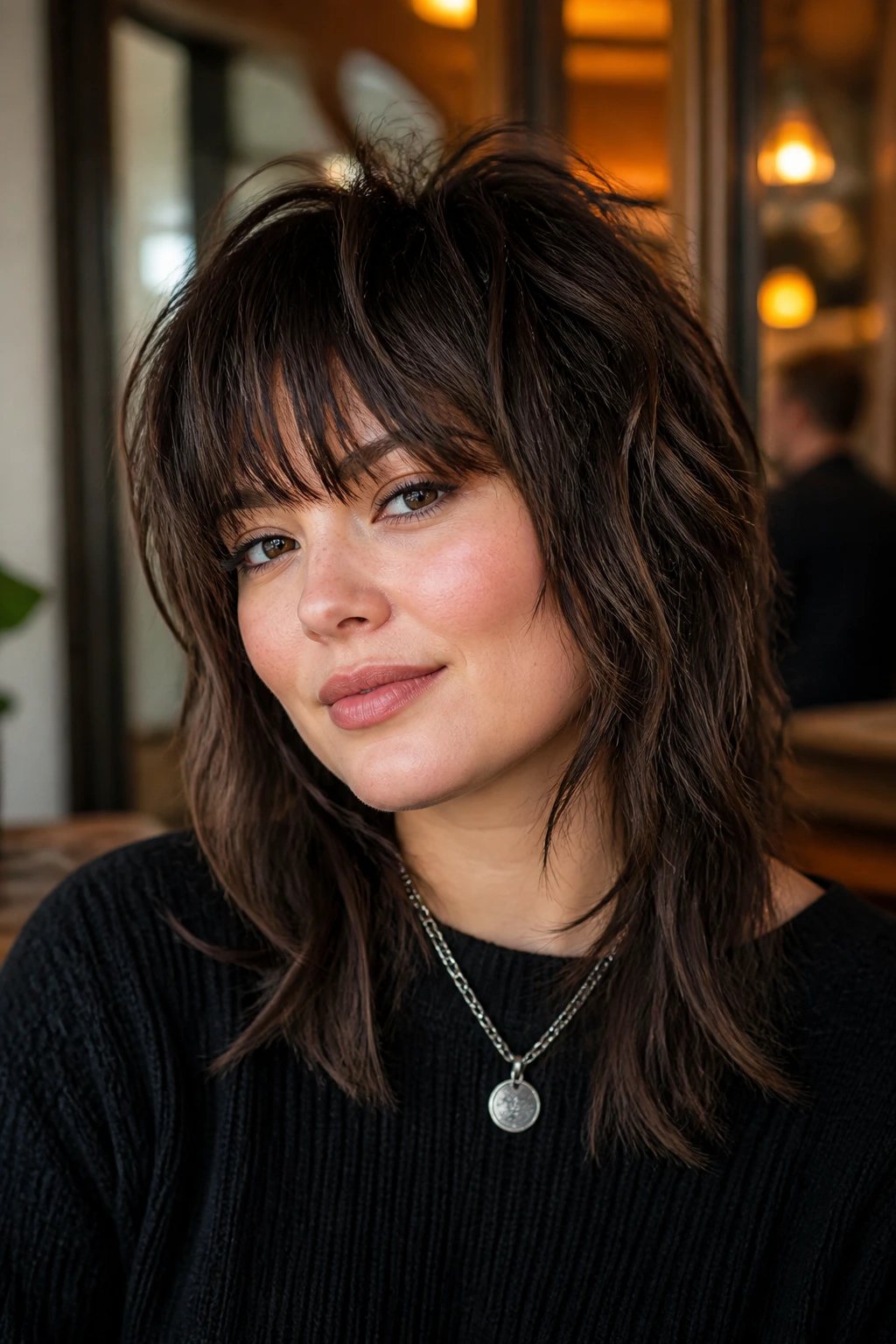
-
Crown lift does the heavy lifting: A little height at the top changes the whole silhouette, and it does more for a round face than adding width at the sides ever will.
-
Broken layers slim the outline: Choppy ends, razored pieces, and feathered texture stop the haircut from reading like one solid circle.
-
Fringe changes the eye line: Curtain bangs, bottleneck bangs, and side-swept fringe all interrupt the forehead without making the face look boxed in.
-
Asymmetry keeps things from feeling too sweet: An off-center part or one longer front piece makes the cut feel sharper and keeps the roundness from taking over.
-
Movement matters more than perfect shape: Rocker hair works because it bends, flips, and separates a little as you move. Still. That little bit of mess is the point.
1. Chin-Length Razored Shag with Curtain Bangs
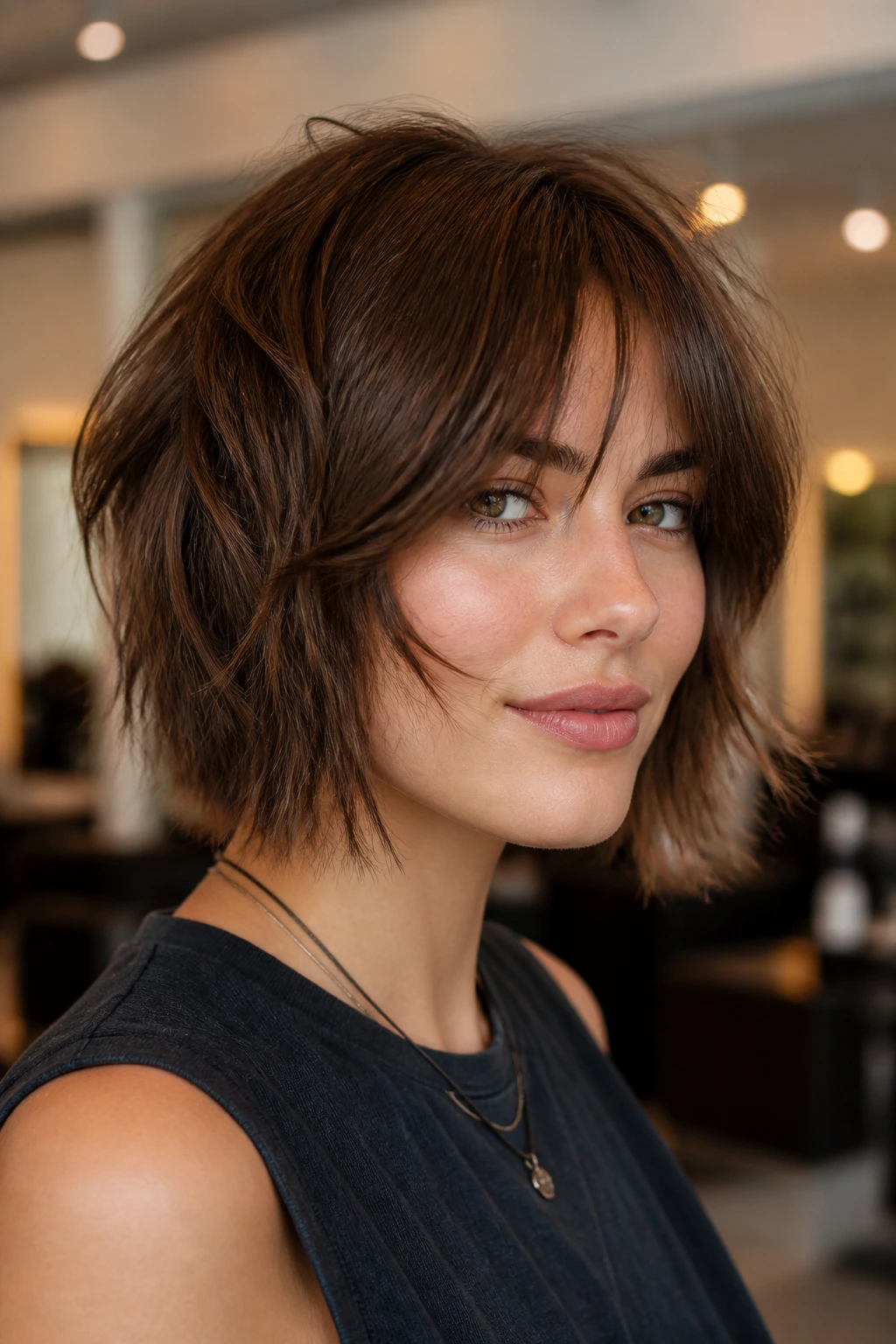
A chin-length shag can work beautifully on a round face when the layers are razored instead of chopped into a blunt bell shape. The secret is that the perimeter skims the jaw, while the curtain bangs split in the middle and fall around the cheekbones like they were cut to do exactly that. It feels sharp without turning severe.
What Makes It Work
The chin length keeps the eye traveling downward, which is the whole game on a round face. The curtain fringe breaks up the forehead, and the razored texture keeps the hair from sitting in one heavy block at the cheeks. If you wear glasses, this cut still plays nicely because the bang can land above, beside, or just past the frames.
Ask your stylist to keep the shortest face-framing pieces below the widest part of the cheeks. That one instruction matters more than people think. If the layers start too high, the cut widens instead of lengthening.
Best for: hair that has some natural bend, medium density, and a willingness to look slightly undone.
Styling note: a fast blow-dry with a round brush at the crown, then a finger-tousle with a pea-size texture cream, gives it that rocker finish without making it fussy.
2. Collarbone Wolf Shag with Broken Ends

The collarbone wolf shag is one of those cuts that looks a little dangerous in the best way. It drops low enough to lengthen the face, but the broken ends keep it from feeling heavy or polished. On a round face, that extra length at the collarbone is doing a lot of quiet work.
What I like here is the contrast. The top can stay airy and slightly messy, while the bottom takes on a rougher, more pointed edge. That stops the haircut from rounding out at the cheeks, which is where a lot of medium-length cuts go wrong. You get volume, but not the soft balloon shape that makes a face read fuller.
This version is especially good if your hair wants to puff when layered too short. Let the motion happen lower. Let the sides stay a little narrow. The haircut looks cooler for it.
3. Cropped Punk Shag with Micro Fringe
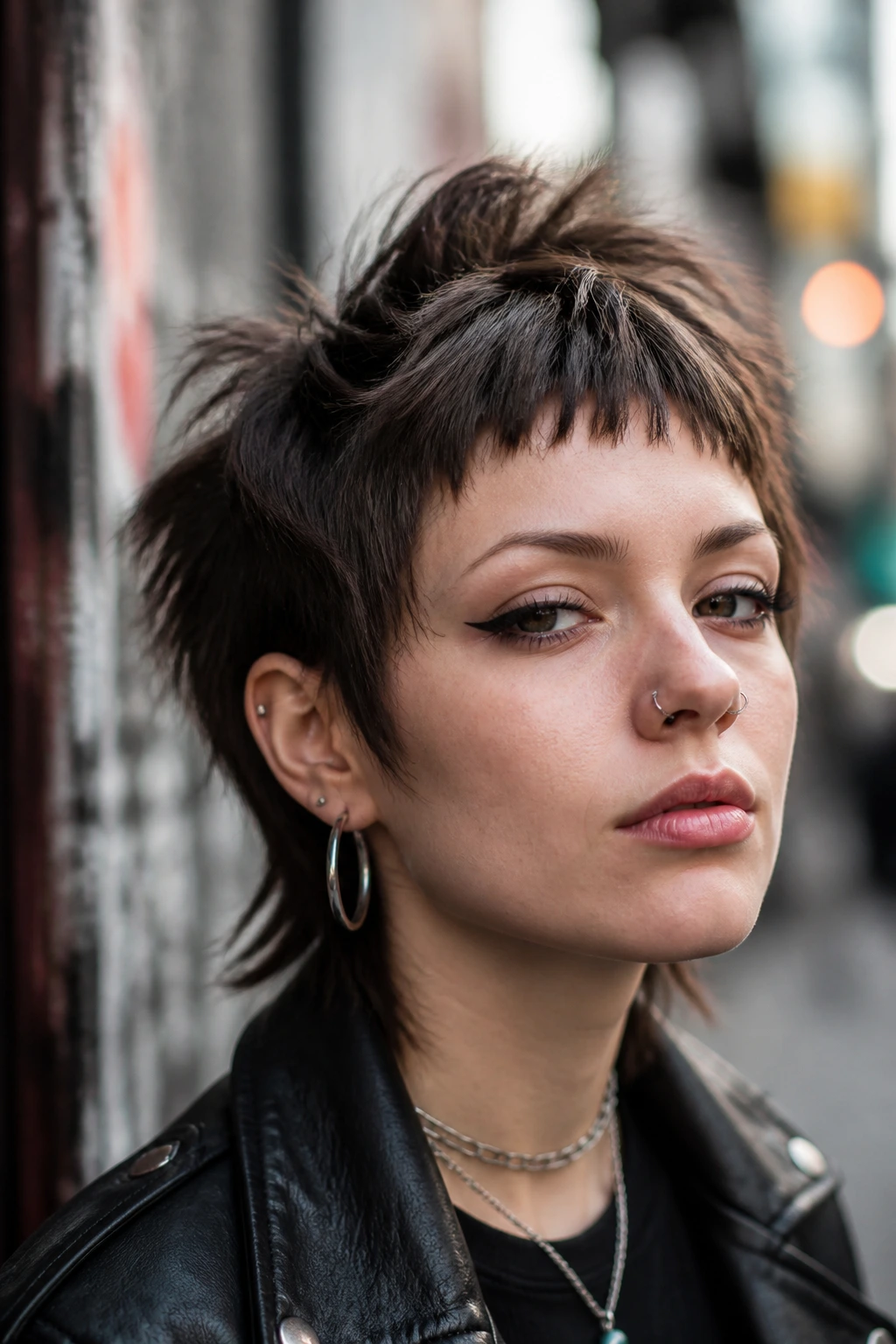
Can a very short shag flatter a round face? Yes, if the shape is cut with enough attitude to keep the eye moving upward.
A cropped punk shag relies on crown lift, shorter top layers, and a tiny fringe that sits above the brows instead of cutting straight across them. The sides should stay wispy and broken, not full and square. That keeps the face from looking boxed in. If the cut is too even, it starts to feel helmet-like fast.
Why It Flatters
The shortness exposes the neck and jaw, which creates a longer read than a bulky bob ever could. A micro fringe sounds bold because it is bold, but on a round face it works when the rest of the shape stays narrow and textured. You want edge, not weight.
This is a better choice for someone who styles hair with their hands and doesn’t mind a bit of re-shaping during the day. A dab of matte paste at the roots and a quick pinch through the ends is enough. No need to polish it. That would kill the whole point.
4. Long Layered Shag with Sweeping Fringe
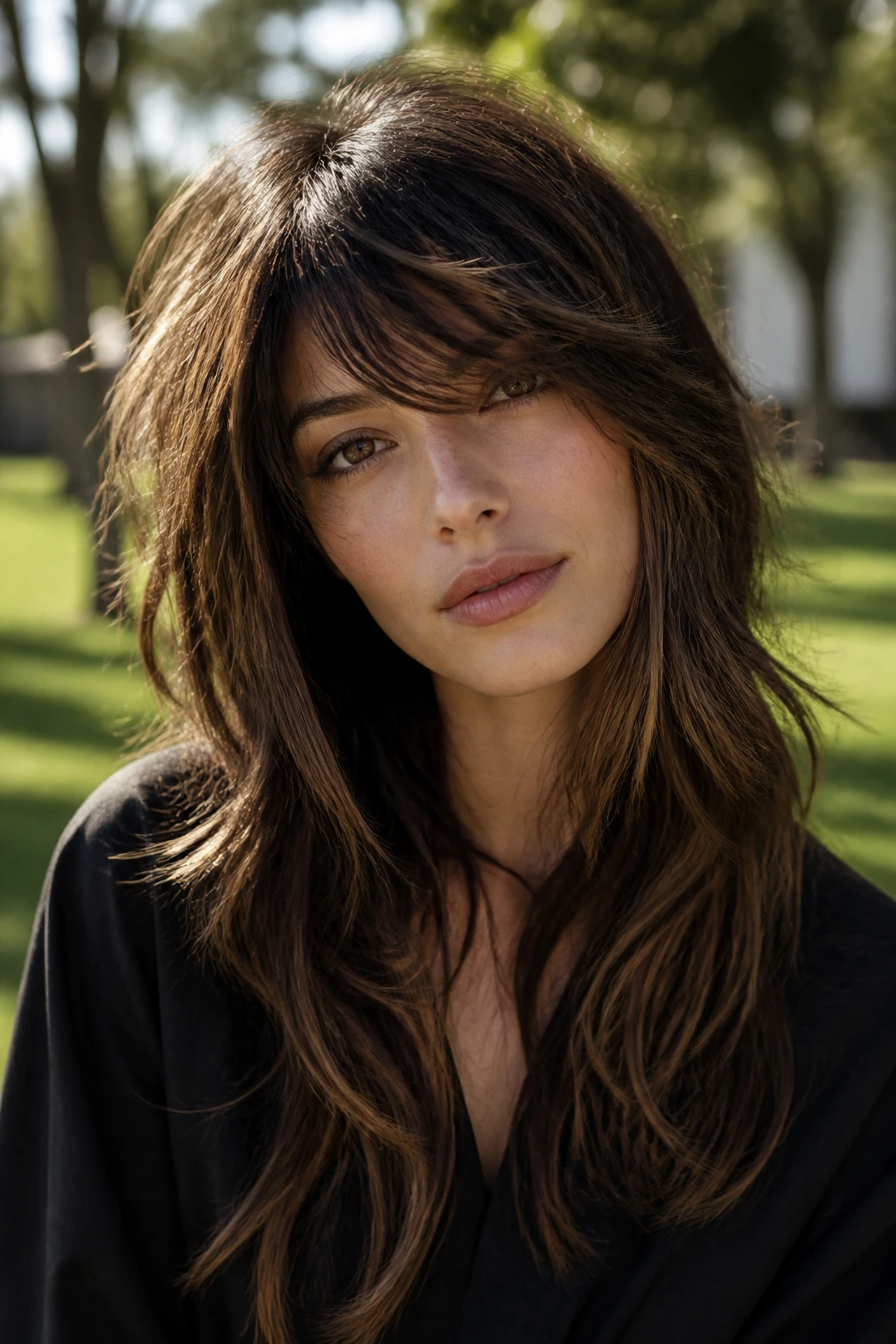
Long hair on a round face can be gorgeous, but only if the cut does some shaping for you. A long layered shag with a sweeping fringe keeps the length, adds rocker texture, and stops the hair from hanging like one straight curtain on either side of the face.
The fringe here should sweep diagonally, not sit flat across the forehead. That diagonal line gives the face a little tilt, which is exactly what makes the shape feel less symmetrical and less wide. The layers themselves should start around the mouth or below, then break into softer points as they go down. That’s the part people skip when they just ask for “long layers.”
If your hair is thick, this version can get bulky fast unless the interior is thinned a bit. If your hair is fine, you’ll want the opposite approach: keep the layers long enough to hold their own and avoid over-thinning the ends. Either way, the fringe and the face frame need to stay mobile.
5. Curly Crown-Lift Shag

Curly hair and a round face can get along just fine when the cut respects the curl pattern instead of trying to tame it into a triangle. A curly shag with crown lift creates height up top, then lets the curls fall in airy pieces around the jaw and collarbone. That upward energy is what makes it work.
How to Keep the Curl Pattern Open
The best version uses internal layers, not aggressive thinning. You want the curls to spring, not frizz out into a wide halo. If the stylist cuts each curl while it’s dry or nearly dry, the shape usually lands better because they can see how much shrinkage is happening.
Skip heavy creams that flatten the roots. Use a light mousse at the crown, then a curl cream only through the mid-lengths and ends. The lift at the top should stay visible, or the whole cut loses the rocker feel and just turns into volume for volume’s sake.
This one is especially good if your curls naturally stack around the cheeks. The point is to let the hair rise before it expands. Tiny difference. Big effect.
6. Shoulder-Length Shag with Bottleneck Bangs
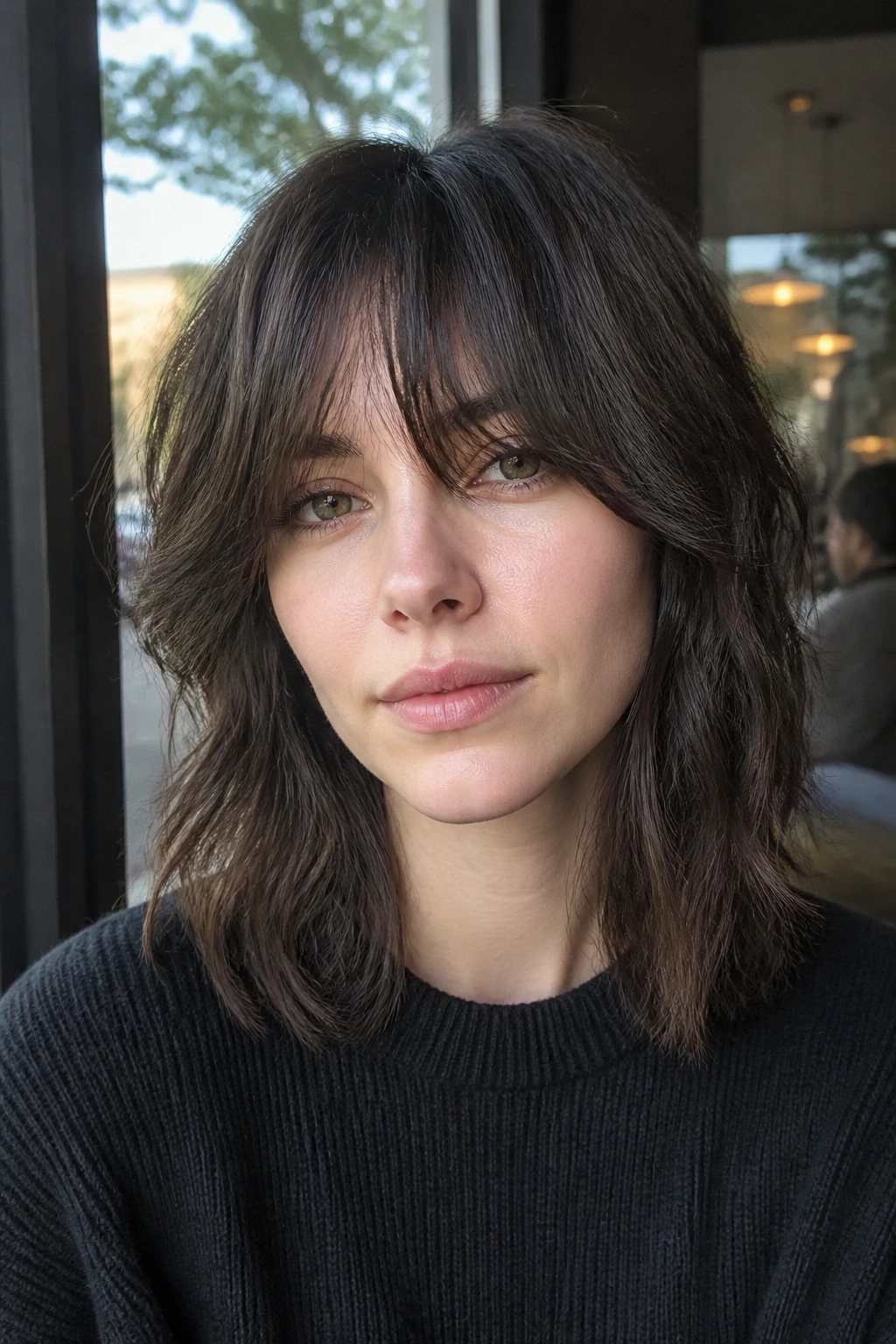
The bottleneck bang is one of the smartest fringe choices for a round face because it starts narrow at the center, opens a little at the eyes, and then tapers into the sides. It gives shape without slamming a horizontal line right across the forehead.
At shoulder length, the cut lands in that useful middle zone where the hair has enough weight to move, but not enough to collapse around the jaw. That’s what makes the shag feel polished enough for everyday wear while still carrying the rocker texture in the ends. The shoulders also act like a natural frame, so the face doesn’t get swallowed up by too much length.
This is the cut I’d point someone to if they want texture without going full wolf cut. It’s less aggressive, less choppy, and easier to grow out. The fringe does the face-shaping, while the layers take care of the movement.
7. Feathered ’70s Rocker Shag
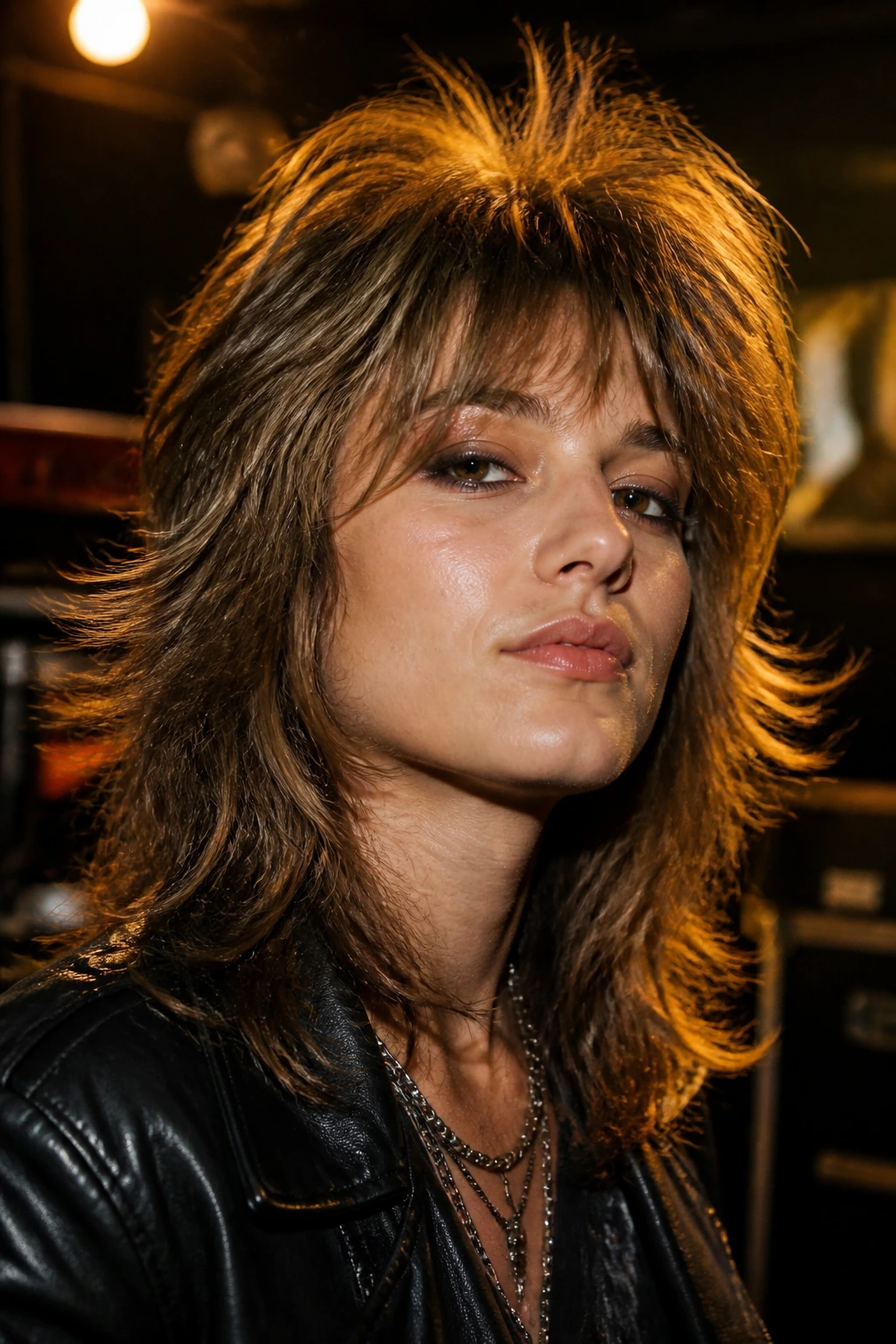
Feathered shags have a specific kind of swagger. The top is light, the sides flick outward just enough, and the whole cut feels like it was made for a live mic and a leather jacket. On a round face, the trick is to keep that feathering higher and lighter near the crown rather than letting the widest part sit at the cheeks.
What to Ask For
- Keep the crown layered enough to create lift without puff.
- Let the front pieces flick away from the face instead of hugging it.
- Softly taper the ends so they don’t build a wide, round outline.
- Use a blow-dry or roller set if you want the feathering to stay visible.
A lot of people think feathered hair is soft in a sugary way. It isn’t, not when it’s done with a rocker edge. It can be sharp, a little wild, and very flattering because it keeps the outline moving. If your hair is fine, this shape gives you body. If your hair is thick, it removes that dead, stuck mass that can make the face look heavier.
8. Side-Parted Shag with Cheekbone Veil
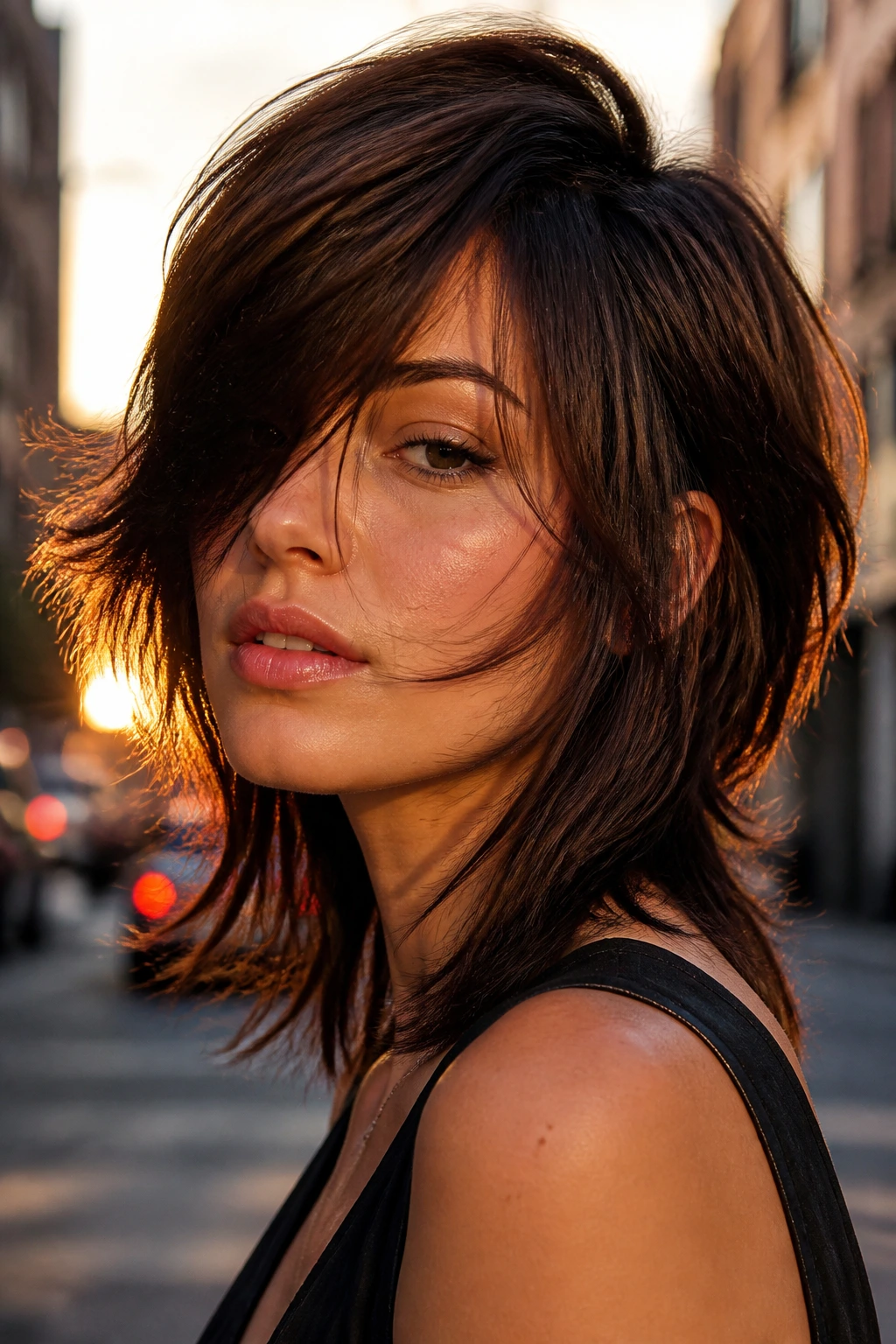
A deep side part can be a round face’s best friend when the rest of the haircut is built with a little attitude. The side-parted shag with a cheekbone veil drops one front section across the face in a soft line, then leaves the other side more open and lifted. That asymmetry changes everything.
The veil piece should skim the cheekbone, not sit directly on it. That sounds like a small detail, but it’s the difference between slimming and widening. If the front piece hits the broadest part of the face and ends there, it can feel heavy. If it falls a little longer and softer, it creates a diagonal line that works harder.
This cut looks especially good when one ear is tucked and the other side stays loose. That slight mismatch makes the whole style feel intentional, not cute in a predictable way. A tiny bit of matte texture at the ends keeps the veil from going limp.
9. Layered Lob with Razor Ends

A layered lob is the quiet one in the group, but don’t mistake quiet for boring. Razor ends give the line a slightly torn-up edge, which keeps the haircut from sitting like a smooth shelf around the face. On a round face, that little bit of damage is a gift.
The lob length lands between the chin and the collarbone, which gives you some vertical pull without forcing the hair too long. The layers should be subtle but active, with enough movement to avoid that solid block effect. If your hair is naturally straight, this is where a styling bend helps; even a few loose waves can keep the shape from feeling too neat.
Best for people who want rocker energy without a big commitment.
It’s also one of the easiest cuts to grow out. If the fringe gets annoying, you can tuck it. If you want more edge, you can rough-dry it and add texture spray. If you need it to behave for work, a flat iron with one soft bend at the ends keeps it from looking too severe.
10. Full-Fringe Shag with Soft Sides

A full fringe on a round face sounds risky, and if it’s cut wrong, it is. But a full fringe with soft sides can be one of the strongest shapes in the whole lineup because it gives the face a strong top line while the sides stay light and broken.
The fringe should not be a hard wall. It needs tiny gaps, a bit of movement, and maybe a center part that wants to split just a little. That way, the forehead gets coverage without the face losing all openness. The sides should stay slimmer than the bangs. That contrast matters.
This cut works best when the bangs are dense enough to matter but not so blunt that they flatten the face. If you have a longer forehead and round cheeks, it can be a sweet spot. If your forehead is short, ask for a lighter version and keep the fringe slightly sheer.
11. Airy Fine-Hair Shag

Fine hair can wear a shag, but it needs the right kind of layering. Too many short layers and the whole thing disappears. Too few and it lies flat against the scalp like it gave up halfway through the day.
The Shape That Saves Fine Hair
The airy fine-hair shag keeps the crown light, uses long internal layers, and avoids over-thinning the ends. That lets the hair look fuller without building a bulky rim around the cheeks. The texture should feel separated, not wispy in a sad way.
A root-lifting mousse at the roots and a little dry texture spray through the mid-lengths are enough. You do not need a gallon of product. Fine hair gets greasy fast, and the more product you pile in, the faster the shape collapses. A round face benefits most when the lift stays at the top and the sides stay slightly open.
If your hair is pin-straight, ask for a few invisible layers that only show once the hair bends. That keeps the cut from looking sparse. It also gives you a little rocker grit without exposing too much scalp.
12. Thick-Hair De-Bulked Shag

Thick hair can make a round face look fuller if it’s cut with too much width near the cheeks. The fix isn’t to hack it all off. It’s to remove weight in the right places so the hair can move instead of sitting as one giant shape.
This version uses hidden internal layers and a softer perimeter. The bulk comes out from underneath, especially around the nape and mid-lengths, while the outer shape stays shaggy and broken. That keeps the hair from puffing out like a triangle. It also makes styling less of a chore, which thick-haired people appreciate immediately.
A good de-bulked shag should still have body. Flat is not the goal. You want the hair to fall in pieces, swing when you turn your head, and keep the sides from sprawling outward. If you’ve ever had a shag that felt too wide, this is the correction.
13. Wavy Bedhead Shag
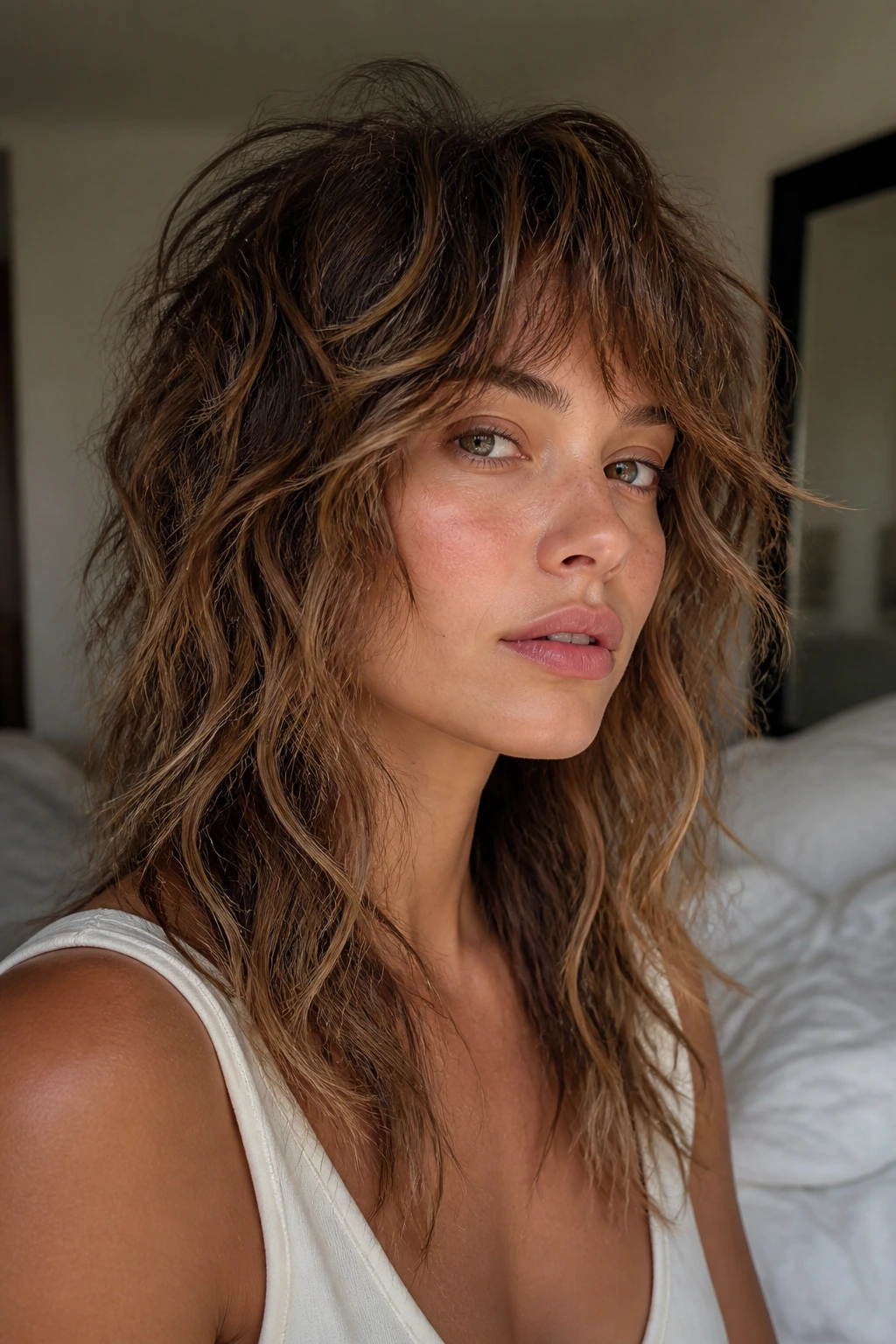
Wavy hair and a shag haircut are old friends, but the round-face version needs a bit of planning so the waves don’t pile up at the cheeks. A bedhead shag keeps the texture loose, a little rough, and easy to air-dry, which is half the charm.
The trick is to let the wave pattern start moving from the crown down, not from the cheekbone out. That means the shortest layers need to live above the widest part of the face, while the front pieces drift below it. If the wave hits the cheek and stops there, the face looks wider. If the wave drops lower, it lengthens the whole outline.
A sea-salt spray can work here, but I prefer a light mousse on damp hair first. Salt spray alone can make some waves feel crunchy and dry. The rocker look is better when the ends still move. A little bend, not a cement helmet.
14. Sleek Razor Shag
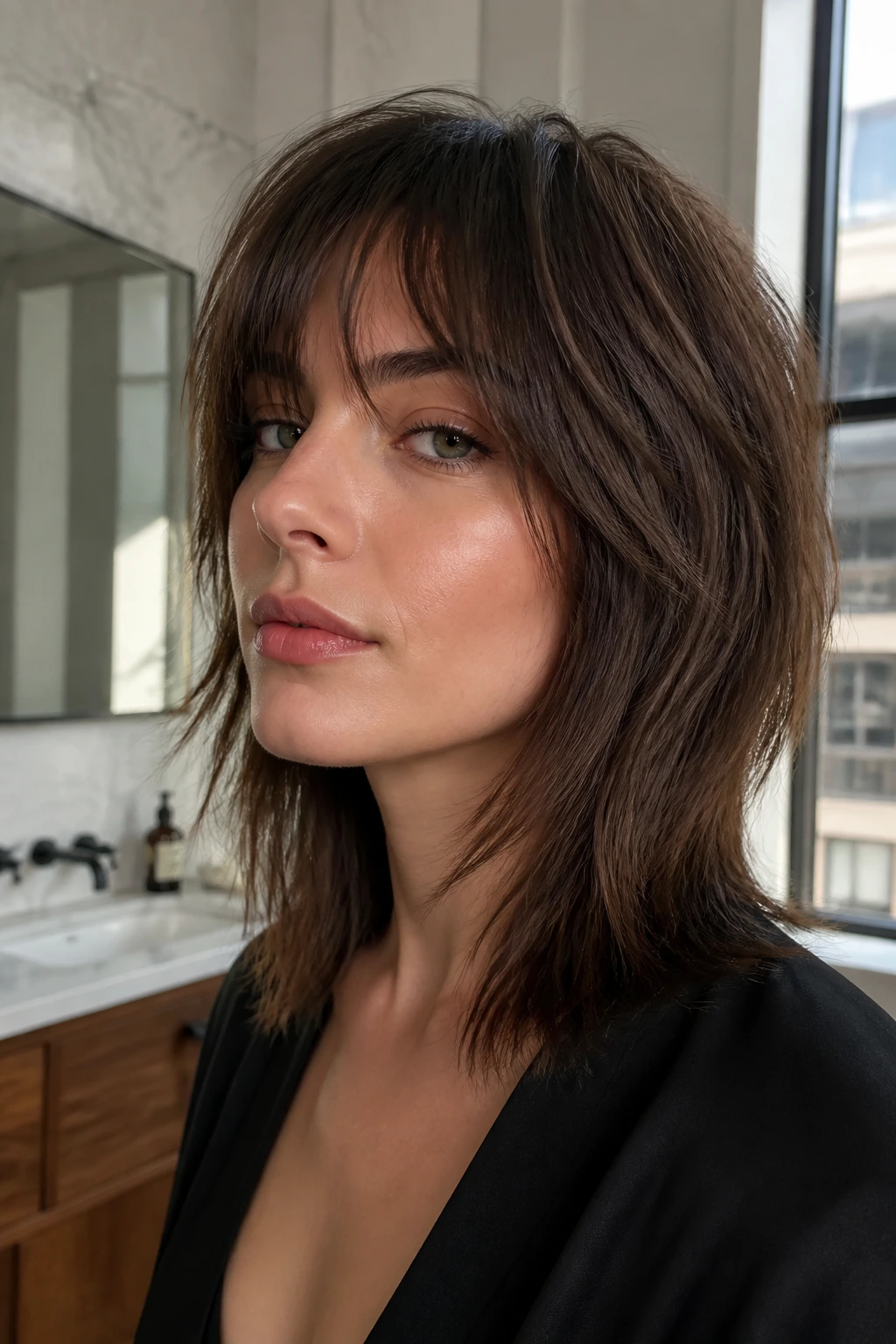
Not every rocker shag has to be huge and wild. A sleek razor shag keeps the movement, but the finish is cleaner and the texture is more deliberate. On a round face, that contrast can be useful because the sleekness keeps the sides from blooming outward.
The hair should be cut with razor-soft ends and then styled with a flat iron just enough to bend the layers, not straighten them dead-flat. That slight bend is what gives the style life. If you iron every strand poker straight, the whole cut can lose the edge and start looking thin in the wrong way.
This is a nice choice if you like dark liner, sharp jackets, and a little bit of drama without too much volume. It reads more polished than the messier shags, but it still has bite. The face frame should stay longer than the cheekbone, or the style can feel too boxy.
15. Piecey Pixie-Shag
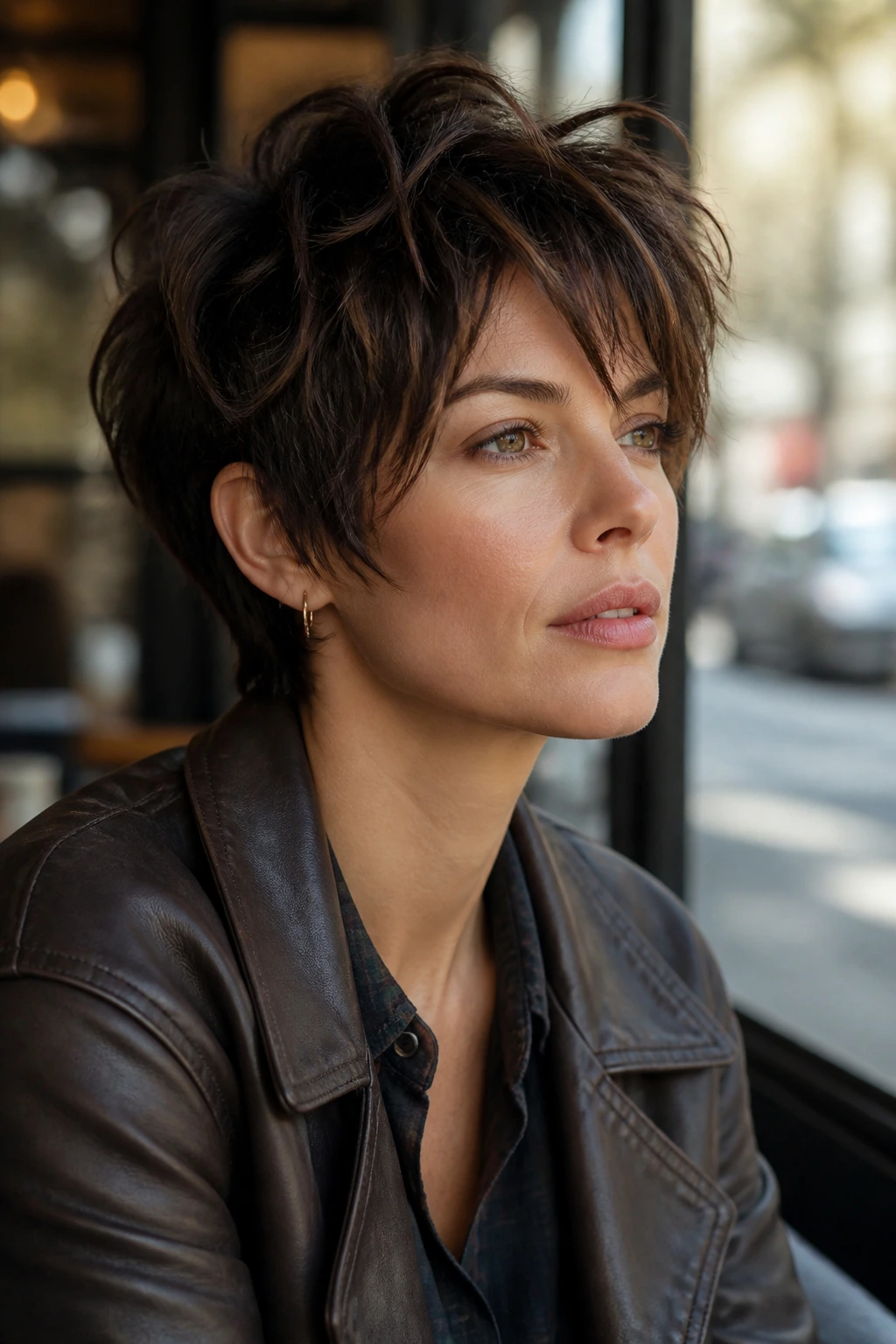
A pixie-shag is short, but it isn’t sweet. It has enough length on top to create lift, enough fringe to soften the forehead, and enough broken texture around the ears to keep the face from looking too round. The shortness opens the neck, which is a big deal on fuller cheeks.
Where the Shape Should Sit
- Keep the top longest, so the eye goes up first.
- Leave side pieces soft and separated, not clipped into one smooth shape.
- Taper the nape to remove bulk from the back view.
- Add a tiny bit of roughness around the fringe so it doesn’t feel too neat.
This cut needs confidence and a stylist who knows how to cut texture into short hair without making it puffy. If you want something edgy that still flatters a round face, this is a good lane. It’s not a helmet. It’s a haircut with movement and a little attitude.
16. Shoulder-Skimming Shag with Bottleneck Fringe

Shoulder-skimming length is useful because it gives the hair enough weight to sit with a little control, but not so much that it drags the face down. Add a bottleneck fringe, and suddenly the whole cut gets smarter. The fringe narrows at the center, opens at the eyes, and narrows again as it blends into the sides.
That shape matters on a round face because it breaks up the forehead without making a hard bar across it. The shoulder length helps the face look longer, while the feathered layers keep the sides from building too much width. If your hair has a bit of wave, this cut comes alive with almost no work.
I’d call this one the “goes with everything” rock shag. It doesn’t scream. It moves. And when the layers hit the shoulders and flip a little at the edges, the shape feels intentional even on a lazy day.
17. Flip-Out Feather Shag

A flip-out shag can go wrong fast on a round face if the ends flare out at cheek level. So the rule is simple: keep the flip lower, around the collarbone or just past it, and keep the top lifted enough to balance the width.
Why the Flip Works When It’s Placed Right
The flip-out ends create motion away from the face instead of across it. That’s the difference. The top stays soft and feathered, while the bottom flicks outward just enough to feel playful and rocker-ish. If the flip lands too high, the cut turns wide. If it lands low, it feels chic and slightly rebellious.
This style works especially well with a round face if the front pieces stay longer than the sides. You can rough-dry the roots, use a 1-inch brush or iron on just the lower third, and let the rest stay airy. No need to curl the whole head. A few flips are enough.
18. Deep Side-Sweep Shag

A deep side sweep brings instant asymmetry, and asymmetry is one of the cleanest ways to keep a round face from reading too circular. One side falls over the forehead and cheek, the other side opens up, and the face suddenly has a shape that feels less predictable.
The best version keeps the sweep loose. You want the hair to drape, not clamp to the forehead. If the front is too smooth, it can flatten the root and make the face feel shorter. A little lift at the part fixes that. A little roughness in the ends helps too.
This cut is useful if you like to change your styling from day to day. Sweep it forward for drama, tuck it behind one ear for a sharper line, or push it back with a bit of root powder when you want a bigger crown. It’s flexible, which is part of why it works.
19. Curly Wolf Cut

A curly wolf cut is louder than a standard shag, and that’s the fun of it. The top is short enough to build height, the sides are tapered enough to stay narrow, and the curl pattern does the rest. On a round face, the height is the win.
The shape should be tailored to the curl spring, not cut into a weird pyramid. That means the stylist needs to respect shrinkage and place the shortest pieces where they won’t puff widest. If your curls are tight, ask for softness around the cheek area and more length through the front. If they’re loose, the crown can carry a little more volume.
This one is not for someone who wants the haircut to behave in a perfect line. It’s for someone who wants movement, edge, and enough shape that the curls don’t spread sideways all day.
20. Asymmetrical Shag

Why does asymmetry help so much? Because a round face is already balanced in a gentle, even way. A haircut that leans slightly to one side breaks that symmetry and gives the eye something else to follow.
An asymmetrical shag can be subtle or obvious. One front side might skim the jaw while the other falls a little longer toward the collarbone. The crown stays shaggy and lifted either way. That imbalance keeps the cut from reading soft in a sleepy way. It reads sharper.
This is the style I’d hand to someone who wants rocker energy but doesn’t want to look like they’re trying too hard. The unevenness does the talking. You can keep the overall shape low-maintenance, then let the front pieces do the visual work. A small tilt in the silhouette changes the whole mood.
21. Long Shag with Face Frame Below the Cheekbones
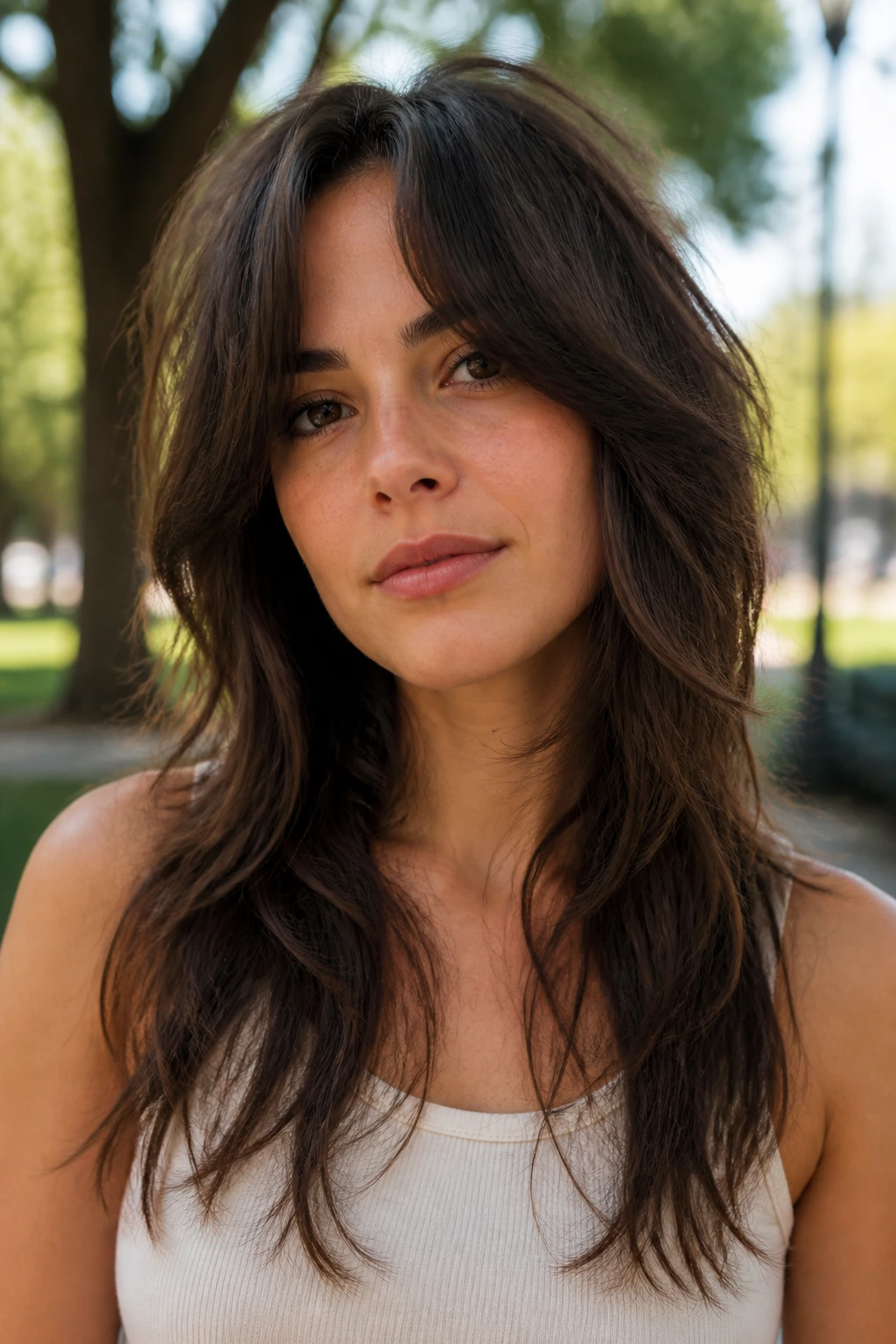
A long shag only flatters a round face if the face-framing starts low enough. Below the cheekbones is the sweet spot. That keeps the hair from sitting exactly where the face is widest, which is the mistake that makes long layers feel heavy instead of slimming.
What to Tell the Stylist
Ask for the first face-framing pieces to begin around the mouth or jaw, then taper them into longer layers through the lengths. You want the front to open the face, not clamp it. The back can stay long and shaggy, but the front needs that downward line.
This is one of the best choices for people who want to keep length while still getting a rocker haircut. The shape is less dramatic than a wolf cut and easier to tuck, braid, or throw into a clip. It also grows out cleanly, which matters if you hate frequent salon visits.
22. Air-Dry Shag for Natural Texture

Some cuts are built for blowouts. This one is built for the towel, the scrunch, and the walk away. An air-dry shag lets natural wave or bend do the styling, which makes it useful for anyone who hates spending 30 minutes wrestling with a round brush.
The shape should be cut with enough internal movement that it doesn’t collapse when dry. On a round face, the important part is where the hair settles: crown lifted, sides broken, ends a little uneven. If the air-dry lands with too much width at the cheeks, the layers need to be rethought.
A light leave-in, a touch of curl cream or wave foam, and a quick finger twist at the front are usually enough. Don’t over-handle it while it dries. That’s how you create frizz and flatten the root at the same time. A good air-dry shag looks a little imperfect in a way that feels very deliberate.
23. Dark Rocker Shag with Blunt Micro Fringe

Dark hair makes texture look sharper. Every choppy layer, every feathered end, every broken point shows up more clearly against a deep base. Add a blunt micro fringe, and the haircut gets a harder edge without needing a lot of length.
This cut works on a round face when the fringe stays tiny and the sides stay light. The hard line at the brow gives the top of the face a firmer shape, while the messy layers below keep the rest from feeling boxy. It’s a bold look, and it isn’t for everyone. Good. Haircuts should have some personality.
If you go this route, the style needs maintenance. A micro fringe grows out quickly and starts behaving differently after just a little length appears. Keep a tiny pair of shears out of the bathroom if your stylist shows you how to do small touch-ups safely, or book fringe trims more often than you would with a longer bang.
24. Platinum Choppy Shag

Platinum color exposes everything. The cut, the texture, the seams between layers. That makes a choppy shag look very alive, but it also means the haircut has to be good because there’s nowhere to hide a bad outline.
On a round face, platinum can be strong if the shape stays narrow at the sides and higher at the crown. Choppy ends help keep the look from turning soft and cloudy. If the hair is overprocessed, though, the texture can get fluffy in the wrong way. I’d rather see a slightly shorter, healthier platinum shag than a fried, overlayered one every time.
This style benefits from regular conditioning masks and a heat protectant that doesn’t leave too much shine. The point is bright color with rough texture, not glossy pageant hair. A little grit looks better here.
25. Copper Sliced-Layer Shag
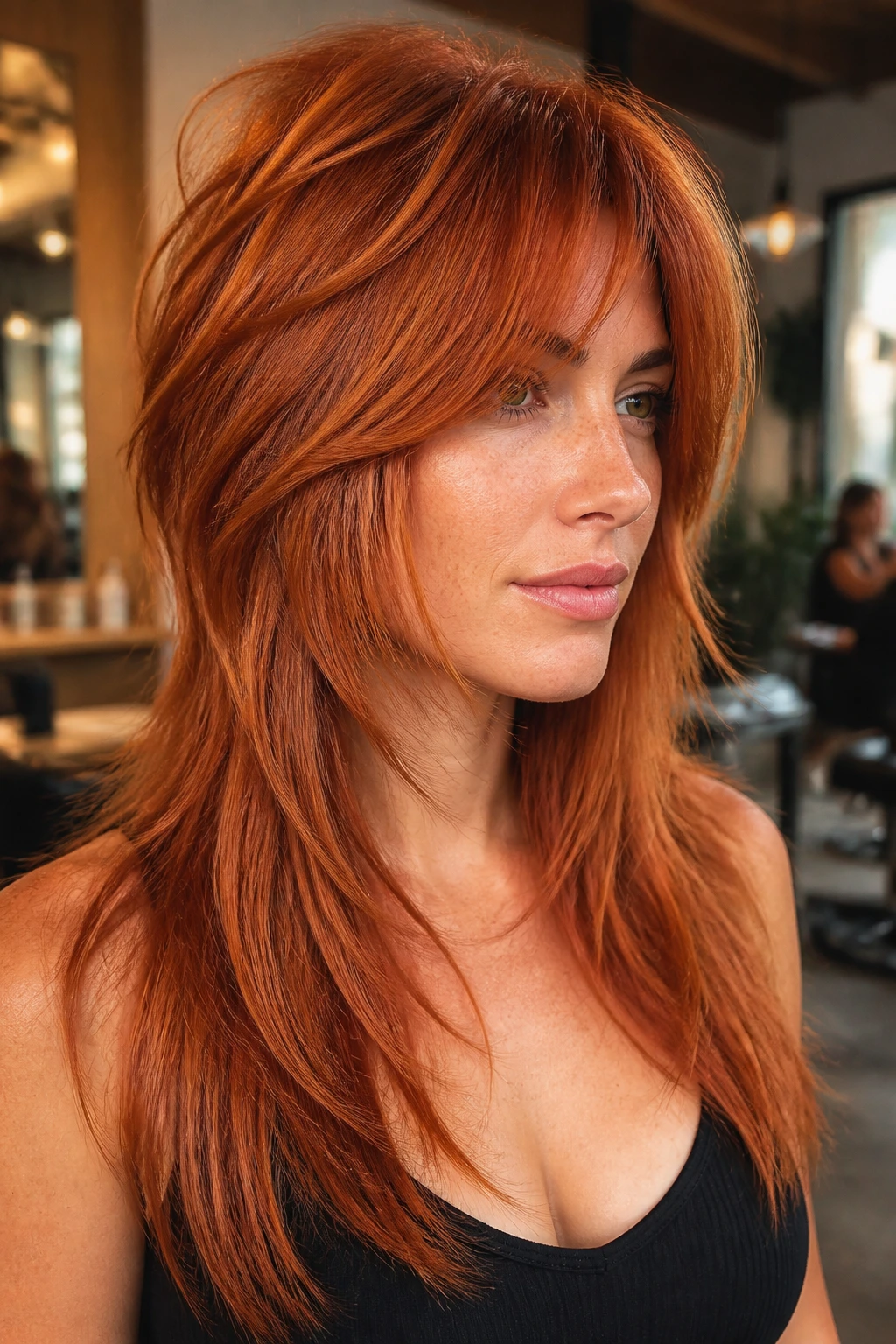
Copper hair and a shag haircut are a good match because the color shows off movement. Sliced layers catch light in different places as the head turns, which keeps the cut from looking flat. On a round face, that movement helps create a longer visual line.
Color and Cut Working Together
The warmth of copper can make a face look brighter, so the haircut has to balance that with shape. Keep the layers staggered and the front pieces long enough to pull downward. If the bangs are too short and the sides too wide, the warmth can make the face look even fuller.
This is a nice option if you want a rocker cut that still feels rich, not punky. The color does some of the heavy lifting, so the haircut can stay a little softer. Ask for sliced layers rather than chunky shelves if you want the ends to move instead of stack.
26. High-Volume Crown Shag

A high-volume crown shag is almost a cheat code for round faces. Height at the top changes the silhouette before anyone notices the details. It’s one of the cleanest ways to stretch the face visually without needing dramatic length.
The sides should stay lighter than the crown. That’s the part people miss. If you build volume everywhere, the shape turns wide. If you put the lift mostly up top and keep the lower half broken up, the face looks longer and the haircut reads rock rather than puffy.
This style does take a little styling effort. A root-lifting spray, blow-dry upside down or with a lift at the part, and maybe a large roller at the crown for a few minutes can make a big difference. Skip that, and you lose the whole point.
27. Razor-Cut Long Shag

A long shag can get dull if the ends are too soft. Razor cutting gives the lengths a thinner, more shredded edge that moves better and doesn’t hang like a curtain. On a round face, that trailing movement is useful because it creates a vertical feel.
The best razor-cut long shag still keeps the face frame controlled. You want the front to skim past the cheeks and then fall lower. If the shortest pieces land right at cheek level, the face can look broader. A lot of people ask for “long layers” and end up with a shape that does nothing. This is the sharper version.
I like this cut for people who want rock hair but also want to be able to put it in a low ponytail without fighting the whole shape. It keeps enough length to be practical and enough edge to feel intentional.
28. Bixie-Shag Hybrid
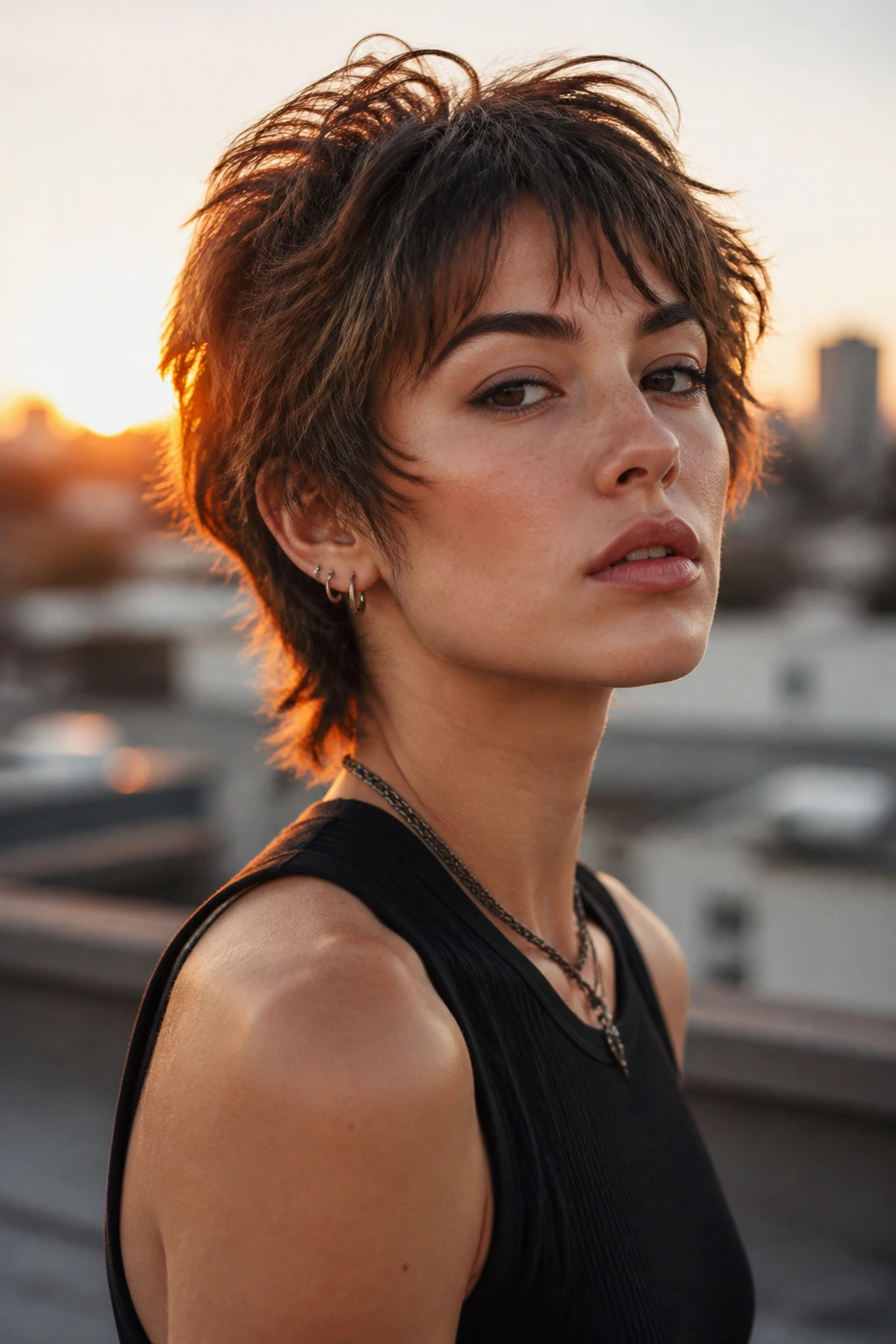
A bixie-shag is where a pixie and a shag meet in the middle and stop trying to be polite. The back stays short, the top stays longer, and the front gets enough length to create movement around the forehead and cheeks. On a round face, the lift on top and the narrowness at the sides are what keep it working.
This cut is excellent if you want something edgy but not super short all over. The top can be styled upward with a finger-dry and matte paste, while the fringe stays a little piecey. It opens up the face more than a bob does and feels less precious than a classic crop.
The biggest mistake here is letting the sides stay too full. The whole shape relies on contrast. Tight at the sides, taller at the top, and broken through the fringe. That’s the formula.
29. Tapered-Nape Shag
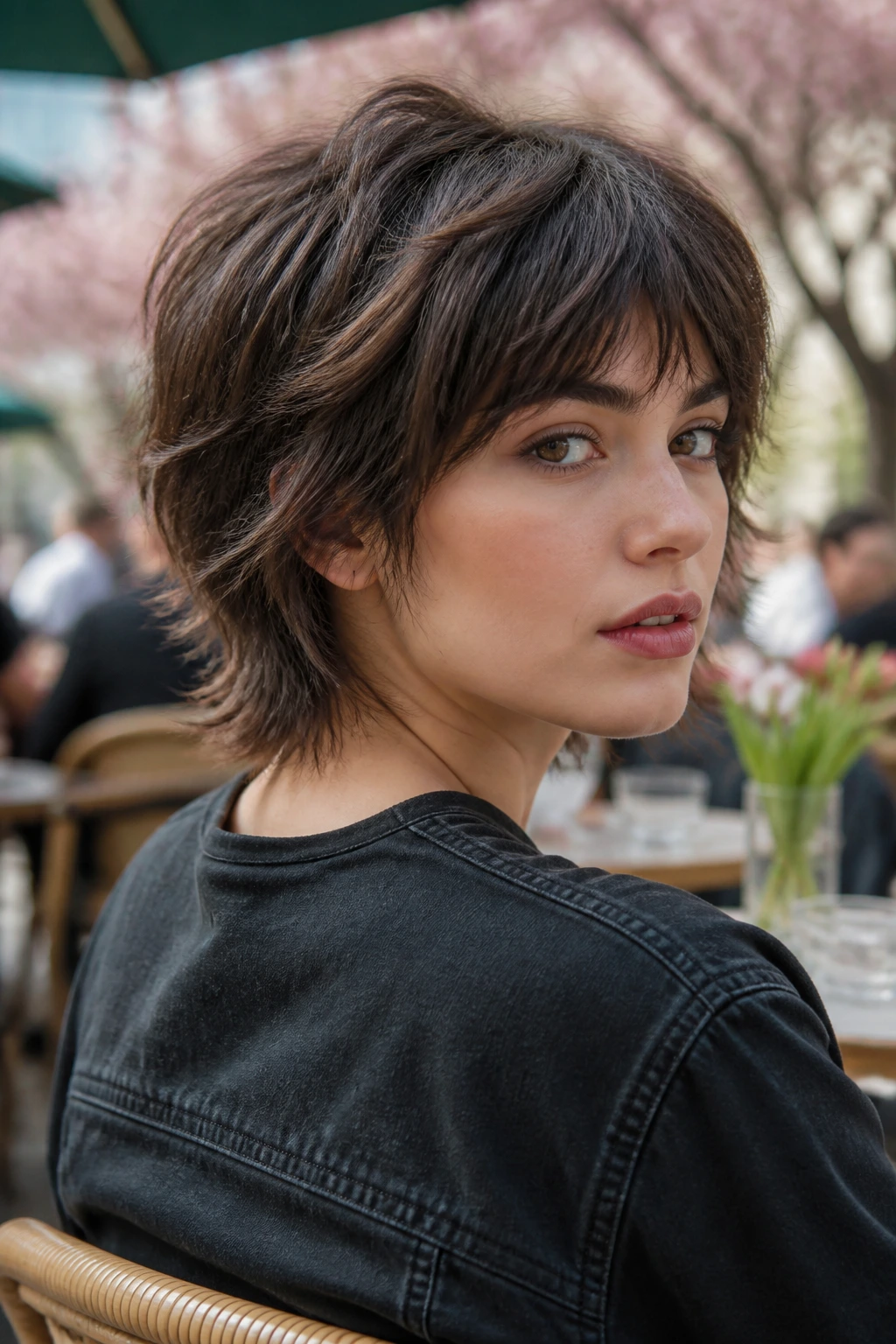
A tapered nape doesn’t get enough credit. It quietly removes bulk from the back of the head, which stops the haircut from looking bottom-heavy. On a round face, that matters because too much fullness in the back can make the silhouette feel short and wide.
Why the Nape Matters
The shag layers can be rough and rocker-ish up top, but the taper underneath gives the style cleaner lines. That contrast is nice. You get texture where people can see it and control where the haircut tends to bulk out. If your hair grows thick at the neck, this is a useful move.
This style is especially good for short to medium lengths. It keeps the neckline open, which helps the whole face read longer. A little lift at the crown and a soft fringe complete the shape. Simple, but not boring.
30. Wispy Baby-Bang Shag

Baby bangs are risky. Wispy baby bangs are much easier to wear because they let air through the fringe and keep the forehead from looking sealed off. On a round face, that lightness matters. A heavy mini fringe can make the face feel shorter. A wispy one can sharpen the whole top line.
The rest of the shag should stay messy and open. If the sides get dense, the tiny bangs lose their point. You want a contrast between the short fringe and the longer broken layers around the cheek and jaw. That contrast is what gives the look its edge.
This is a cut for people who like a little rebellion in their hair and don’t mind regular trims. Tiny bangs grow out awkwardly if ignored. They’re cute when maintained, and very annoying when neglected.
31. Glam Rock Shag with Soft Waves
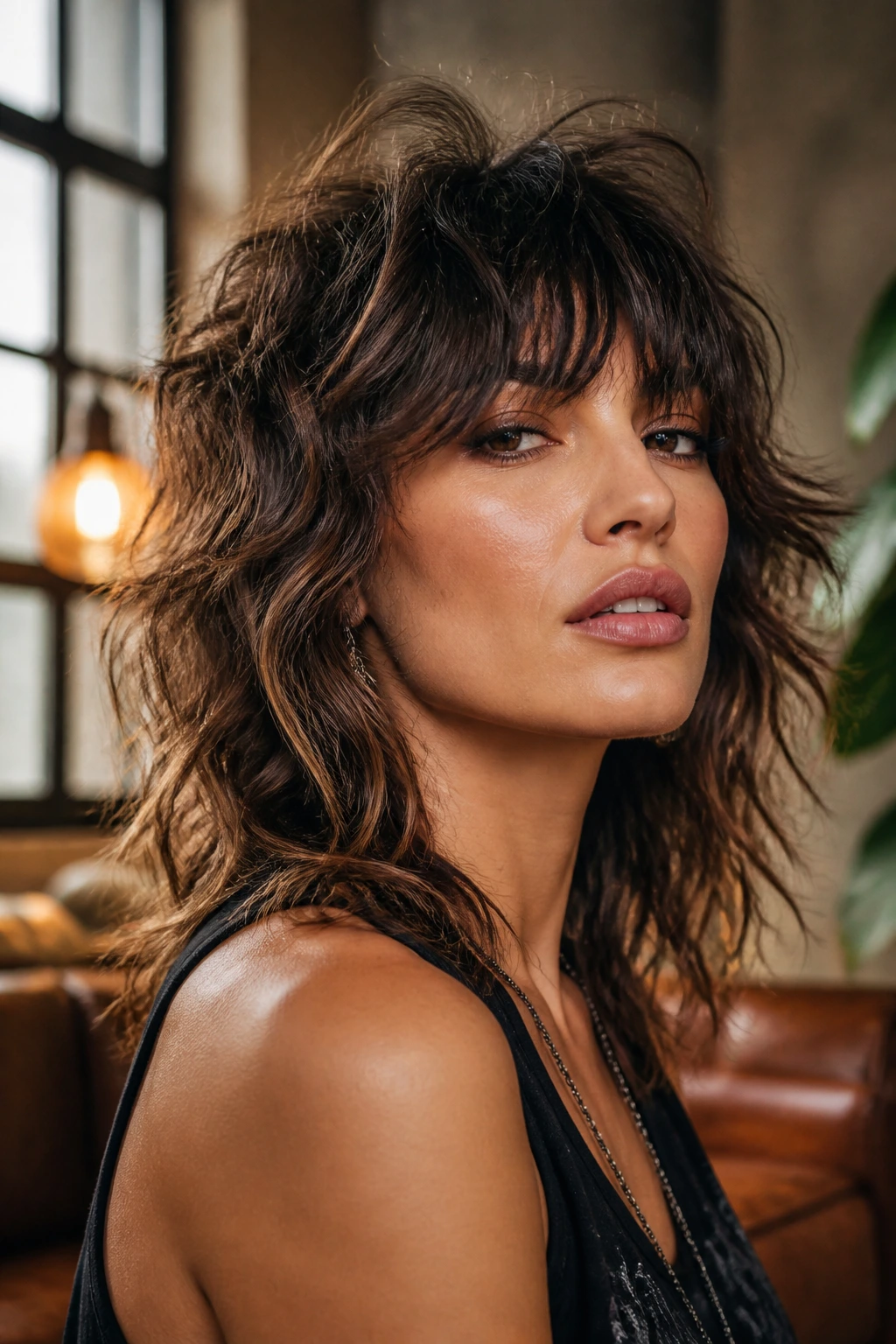
A glam rock shag is not the same thing as “big hair.” Big hair can go soft and round. Glam rock hair needs control inside the chaos. Soft waves, a lift at the crown, and a slightly shattered fringe give the style shape without making it feel stiff.
The waves should bend away from the face instead of rolling toward it. That’s the trick. A couple of loose bends from a curling iron or flat iron, then a finger rake through the ends, gives the style movement without turning it into a prom curl situation. The face stays open, and the texture does the rest.
This cut is nice if you want something a little dressier than a raw shag. It still has edge, but it can handle a jacket, a red lip, and a cleaner outfit without looking out of place.
32. Low-Maintenance Long-Layer Shag
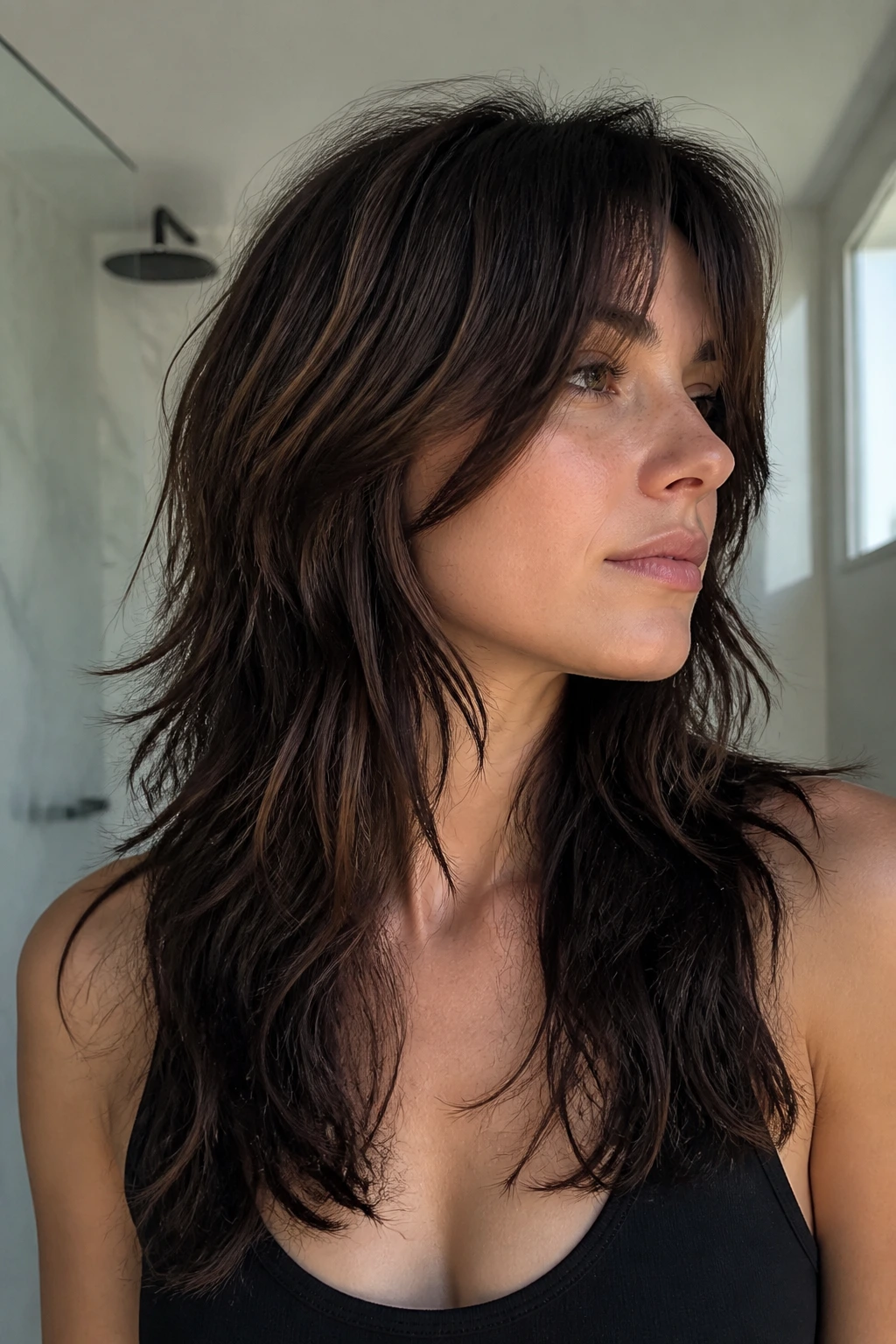
Sometimes the right haircut is the one that still looks decent when you don’t touch it. A low-maintenance long-layer shag does exactly that. The layers are long enough to grow out well, the ends are broken enough to keep moving, and the face frame stays soft without demanding daily styling.
For a round face, the safest route is to keep the front pieces below the cheekbone and avoid too much bulk at the sides. That gives the face a longer line even when the hair is air-dried or half-slept-on. If you like hair that looks better on day two, this is a good candidate.
It won’t give you the strongest rocker attitude in the collection, but it can still read cool if you add a little texture spray or tuck one side behind the ear. Subtle works. Not every shag has to shout.
33. Festival Shag with Braidable Front Pieces

Some shags need a little styling trick to keep them off the cheeks, and braiding is one of the best. A festival shag leaves enough front length to braid, twist, or pin back, which makes it practical for people who want a playful rocker cut that can switch moods fast.
Best Uses for the Front Pieces
- Small face-framing braids when you want more open space at the cheeks.
- Twists pinned back with a couple of bobby pins for heat or humidity.
- Loose half-up sections that keep the crown high and the front light.
- Tiny accent braids woven into the layers when you want the cut to feel more lived-in.
This is a fun cut if you like changing the shape without visiting the salon every week. The braidable pieces give you options, and the shaggy body underneath keeps the haircut from feeling too controlled. It’s casual, but not plain.
34. Peekaboo Underlayer Shag
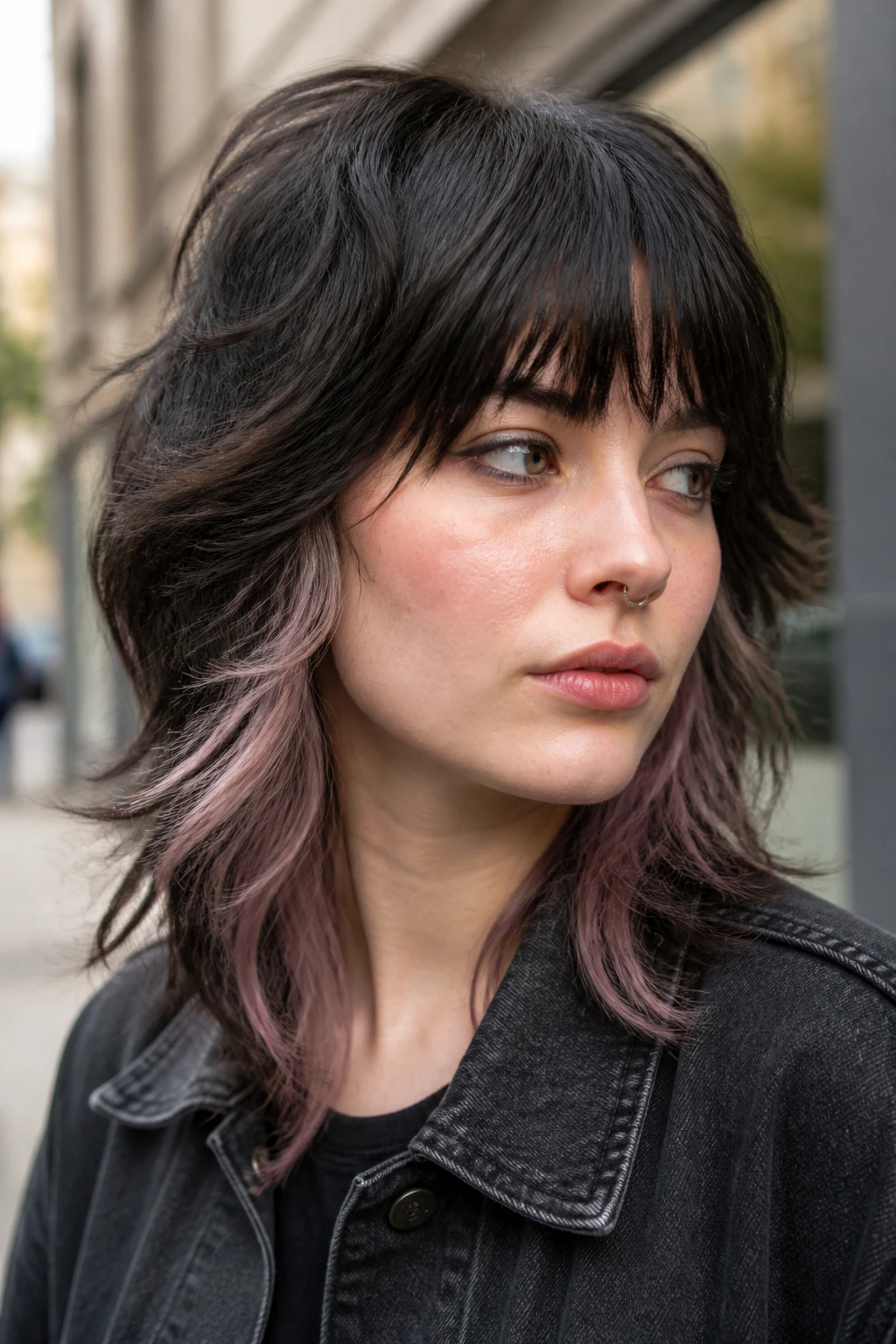
A peekaboo underlayer adds a little surprise when the hair moves. It can be hidden color, a slightly shorter underlayer, or even a subtle undercut that only shows when the top shifts. For a round face, that hidden shape matters because it takes bulk out of the lower half without making the haircut look overly severe from the front.
The top should stay shaggy and full of motion, while the underlayer keeps the outline from puffing out. That contrast can make the whole cut feel lighter and a bit more dangerous. If you like hair that reveals more the second time someone looks at it, this version has a nice payoff.
It’s also useful if your hair is dense and tends to spread wide at the bottom. A peekaboo underlayer lets the outer shape stay soft while the hidden interior does the slimming work.
35. Soft Mullet Shag with Shaggy Crown

The soft mullet is where the rocker factor gets louder, and if it’s done well, it can be a killer match for a round face. The crown stays shaggy and lifted, the sides stay lighter, and the back keeps a little extra length so the cut stretches the eye downward.
The word “mullet” scares people because they picture something stiff and dated. That’s not what this is. The soft version keeps the transitions hazy and the edges broken. The result is more modern, more wearable, and less cartoonish than the old-school version.
This is the style for someone who wants the haircut to say something. It’s not neutral. It has shape, attitude, and enough movement that it won’t sit flat by lunchtime. If you want a shag with bite, this is the one that bites back a little.
The Shape Rules Behind a Better Shag

A shag for a round face lives or dies on where the layers start. Too high, and the hair widens at the cheeks. Too low, and the cut loses its lift and starts hanging like a softened curtain. The best versions place the shortest movement near the crown or upper face frame, then let the length fall past the widest part of the face.
That’s why bangs matter so much. Curtain bangs, bottleneck fringe, side-swept pieces, and broken micro bangs all change the eye line before the rest of the haircut even gets a chance to speak. If the fringe is blunt and wide, the face looks shorter. If it’s airy, split, or angled, the face gets breathing room.
Practical Styling Moves That Keep the Rocker Edge Alive

Root lift first: Start with a volumizing mousse or root spray at the crown before you dry anything else. If the top goes flat, the whole haircut loses shape.
Keep the ends rough: Don’t over-smooth the last inch or two. A little bend, a little texture, a little separation — that’s where the rocker part lives.
Use less product than you think: Heavy cream or oil can make a shag collapse into one soft lump. A round face benefits more from movement than shine.
Style the front pieces on purpose: If the fringe is curtain-shaped or side-swept, direct it with your fingers while it’s damp. Lazy bangs fall in lazy places.
Don’t chase perfect symmetry: A slightly uneven part, one tucked side, or a piece that falls lower than the others can improve the shape. Perfectly even hair often looks too round.
The Mistakes That Make a Round Face Look Wider
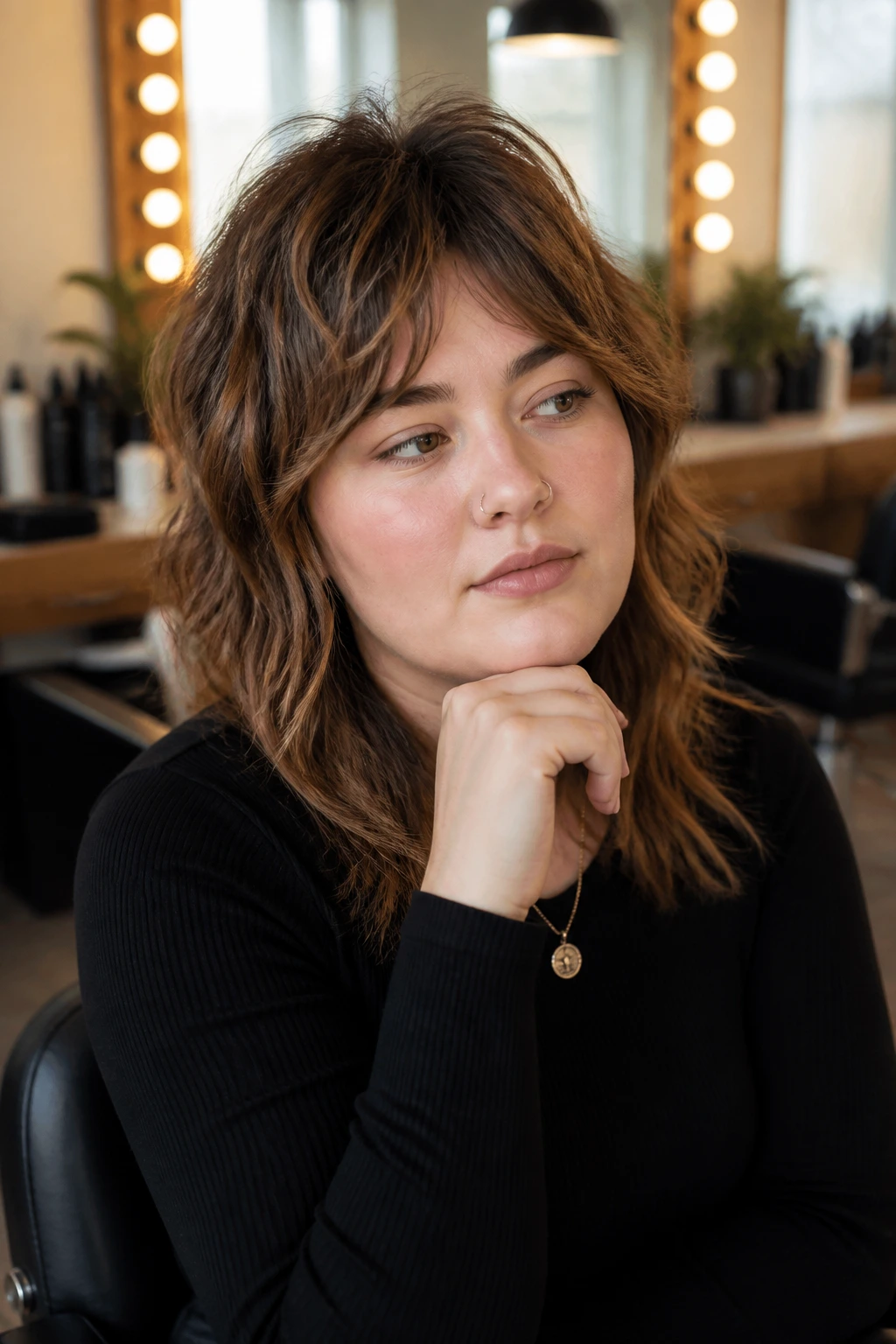
The biggest mistake is putting the shortest layers right at the cheeks. That’s the fastest way to widen the face, and it happens more often than salon photos would suggest. If the layer hits the widest part of the face and stops there, it acts like a visual shelf. The fix is simple: move the shortest face-framing pieces a little lower or a little higher, depending on the cut.
Another problem is too much side volume with not enough crown height. People love texture, which is fine, but if all the bulk sits beside the face, the silhouette gets broader. You want the lift to live on top and the lower sections to stay light and broken.
Heavy, solid fringe can also box a round face in. A blunt band across the forehead narrows the vertical space and leaves no movement around the eyes. If you want bangs, keep them see-through, split, or tapering.
And then there’s the over-thinning issue. Some stylists remove so much bulk that the hair frizzes up or looks scraggly. A shag should look piecey, not stripped. If the ends feel see-through in a bad way, ask for more weight to stay in the outline.
Named Variations Worth Trying

Soft-Edge Shag: Keep the layers longer, the fringe lighter, and the overall shape less chopped. This works if you want the face-slimming effect without a hard rocker finish.
Full Rebel Shag: Shorter top, choppier ends, and a stronger fringe statement. Pick this if you want the haircut to be the loudest thing in the room.
Curly Halo Shag: Built for curls that need internal layering and a lifted crown. It keeps the face open while letting the texture stay big and springy.
Glossy Glam Shag: Similar shape, but styled with softer waves and a cleaner finish. It’s the version that can leave the concert and walk into dinner without changing clothes.
Hidden Undercut Shag: A small undercut or tight nape section removes bulk where it tends to spread widest. Great for thick hair that wants to puff at the sides.
Tools That Make These Haircuts Easier to Wear

-
Blow dryer with a concentrator nozzle: Gives you control at the root and keeps the crown from drying flat.
-
Diffuser attachment: Essential for waves and curls when you want lift without frizz.
-
1-inch curling iron or wand: Handy for adding a few bends through the front pieces and mid-lengths.
-
Round brush, 1 to 1.5 inches: Best for sweeping bangs and building crown shape without over-rounding the sides.
-
Volumizing mousse: Works well on damp roots before a rough dry, especially for fine hair.
-
Texturizing spray: Adds pieceiness to the ends after styling; use it lightly, not like hairspray.
-
Dry shampoo: Useful on day two when the crown starts to droop and the roots need a little grit.
-
Wide-tooth comb: Better than a brush for curly or wavy shags when you want to keep separation intact.
-
Clips and sectioning pins: Make bangs and face-framing pieces easier to dry in the direction you want.
Keeping the Shape Between Salon Visits
Shags grow out better than a lot of layered cuts, but that doesn’t mean they stay perfect forever. Bangs usually need attention first. If the fringe sits near the eyes, trim it every 2 to 4 weeks or ask for a quick salon cleanup. Shorter, choppier versions lose their shape faster.
For the full haircut, plan on a shaping trim every 6 to 8 weeks if the style is short or heavily layered. Longer shags can often go 8 to 12 weeks before they start sagging at the sides. If the cheeks start looking wider again, that usually means the top has gone flat or the front pieces have grown into the face.
At home, dry shampoo helps the crown keep its lift on day two and day three. A tiny bit of leave-in on the ends can stop the hair from turning fuzzy. If you use texturizing sprays often, clarify the hair every 2 to 4 weeks so the product doesn’t build up and dull the piecey texture. Curly and wavy shags usually need more hydration at the ends, while straight shags need more root support. Tiny adjustment. Big payoff.
Questions People Ask Before They Book a Shag
Will a shag make my round face look wider?
It can, if the layers hit the cheeks and the sides get too full. The right shag does the opposite by putting lift at the crown and keeping the face frame below or around the cheekbone instead of directly on it.
What bang style is safest for a round face?
Curtain bangs, bottleneck bangs, and soft side-swept fringe tend to be the easiest to wear. They break up the forehead without cutting the face into a hard horizontal line.
Can I wear a shag if my hair is fine?
Yes, but keep the layers long enough to hold weight. If the cut is too short and too thinned out, fine hair can lose shape fast and show too much scalp.
Is a wolf cut the same thing as a shag?
They overlap, but a wolf cut usually has a sharper contrast between the crown and the length. A shag is often a little softer through the transitions, even when it has plenty of edge.
How often should I trim the shape?
Shorter shags usually need a refresh every 6 to 8 weeks. Longer versions can go a bit longer, but the fringe and face frame may still need small touch-ups sooner.
What if my hair is curly and I hate triangle shapes?
Ask for internal layers and make sure the stylist respects shrinkage. The curl needs room at the crown and softness around the sides, or the shape can widen fast.
Should I ask for razoring or scissors?
It depends on your texture. Razor cutting can create nice separation on straight or slightly wavy hair, while scissors often work better on curls or fragile ends. Bring pictures and talk about how your hair behaves when it’s dry.
Can I wear a shag with glasses?
Absolutely. Just keep the bangs and front pieces clear of the frame line so the haircut doesn’t crowd your face. A side sweep or curtain bang usually plays well with glasses.
What if I want the cut to look rocker, but not loud?
Ask for long layers, broken ends, and a soft fringe rather than a dramatic mullet shape. You’ll still get movement and shape, just with less attitude at first glance.
The Cut That Keeps Its Edge
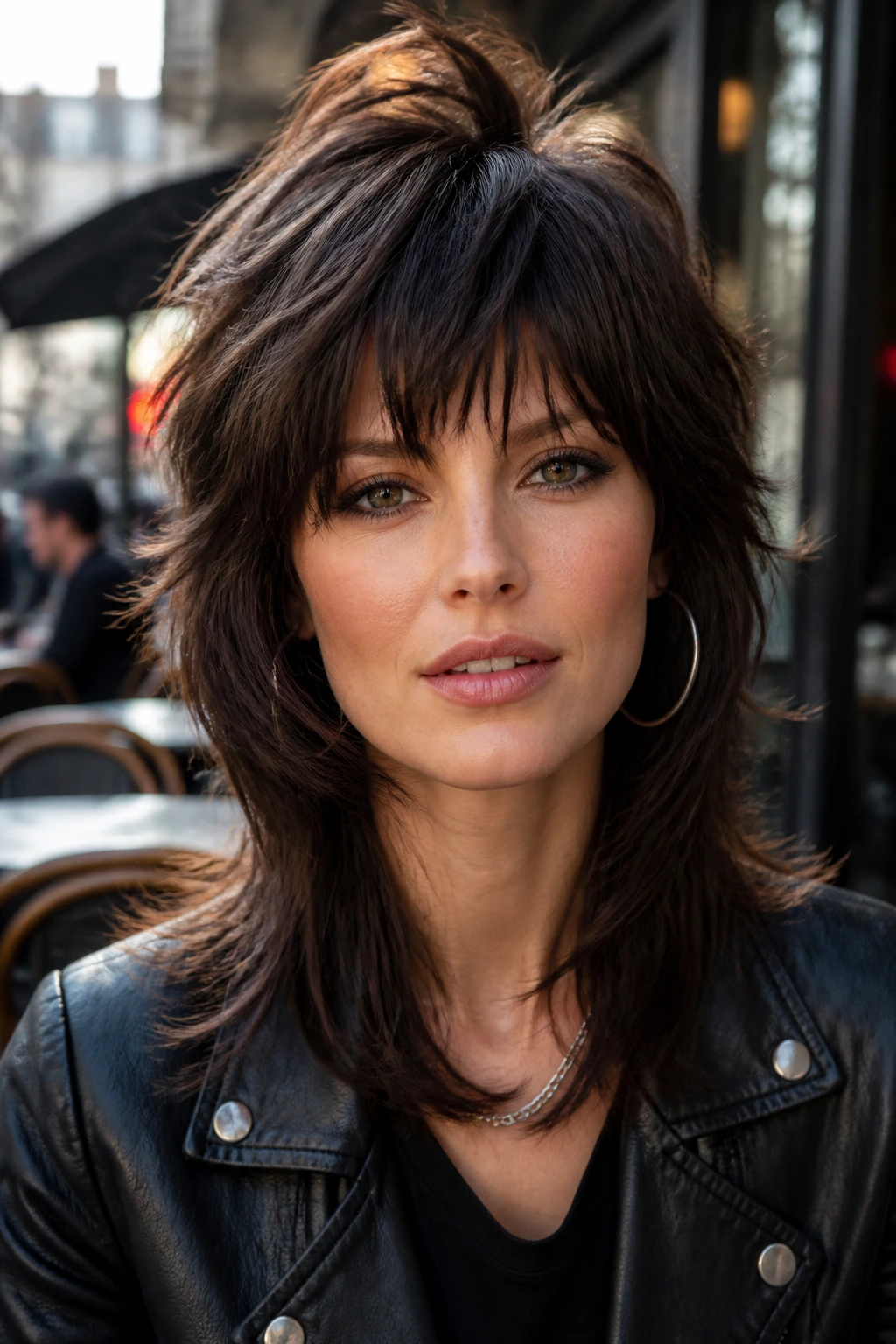
A good shaggy rocker hairstyle doesn’t try to erase a round face. It gives it structure, movement, and a little attitude around the edges. That’s a much better deal. The face stays soft, but the haircut stops it from reading too soft.
The best part is how flexible these cuts are. You can wear them messy, blown out, air-dried, tucked, pinned, curled, or flipped out at the ends, and the shape still makes sense. Bring a few photos, say where your hair tends to puff, and be specific about the fringe. That’s usually where the real difference starts.
