



Thick, straight hair can look expensive one day and boxy the next, and the difference usually comes down to where the weight sits. The best straight long haircuts for thick hair do not fight the density; they put it to work. One clean line, a few carefully placed layers, and the whole head starts behaving.
That sounds simple. It isn’t. Thick hair holds shape, but it also holds mistakes. Cut a blunt edge too high and it kicks out at the ends. Thin it too much and the bottom goes wispy while the crown still feels heavy. The sweet spot is somewhere between blunt and soft, between heavy and carved.
I’ve always thought long, straight hair looks best when the haircut can be read in one glance. You want to see the weight line. You want the front to make sense with the back. And if your hair is dense, coarse, or just plain abundant, the wrong cut makes you spend 20 extra minutes every morning fighting the same puffed-out shape.
Why These Cuts Work on Dense Straight Hair
-
The perimeter stays in charge: Thick hair needs a strong edge, because a weak edge turns fuzzy and spreads out by lunchtime.
-
Movement happens in the right places: A few layers near the face or under the crown can remove bulk without hollowing out the whole shape.
-
Grow-out looks cleaner: Long cuts with a thoughtful outline keep their shape for weeks, not days, which matters when your hair grows fast and heavy.
-
Blow-drying gets easier: When the haircut is balanced, you don’t have to force the ends flat with a round brush for half an hour.
-
You keep length without the helmet effect: The right shape lets thick hair move instead of sitting like one solid block.
-
The cut can match your styling habits: If you wear it straight, tucked, center-parted, or with a slight bend, the haircut can be built around that instead of arguing with it.
1. Blunt Waist-Length Hem
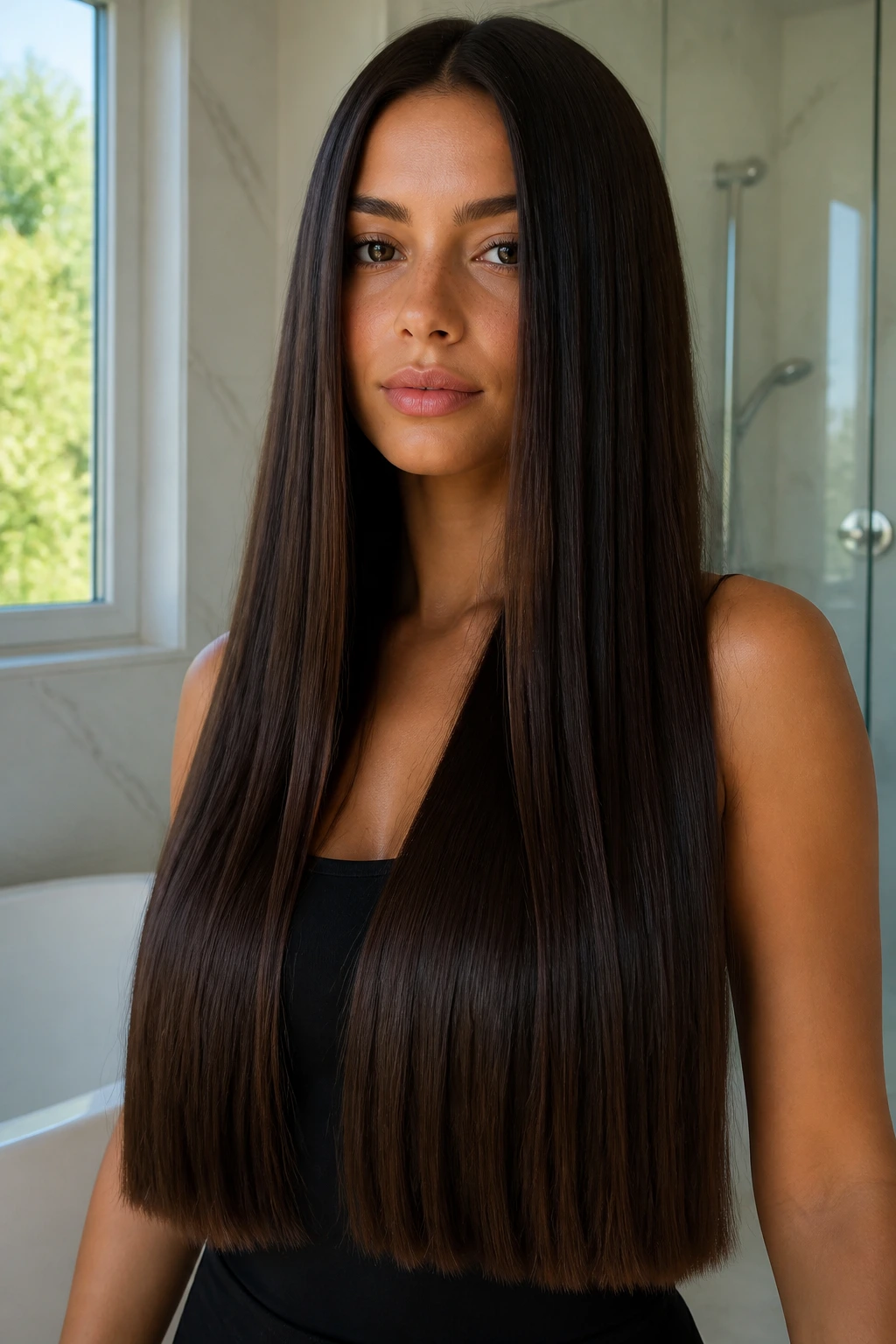
A blunt waist-length hem is the cleanest answer when your hair is thick, straight, and dense enough to look carved rather than fluffy. The edge lands all at one level, so the bottom reads as a firm line instead of a cloud. On hair with real mass, that line looks deliberate, not severe.
Why It Works
The blunt hem keeps every ounce of weight where you need it most: at the bottom. That matters because thick straight hair tends to spread out when the ends are too thin or too feathered. Ask for a dry dusting every 8 to 10 weeks so the hem stays crisp, not frayed.
If your hair gets poofy at the last two inches, this cut is a relief. The perimeter holds the shape, and you can still wear it center-parted or tucked behind one ear without the ends turning ragged. It’s the haircut version of a sharp white shirt.
A tiny note: if your hair is coarse, skip aggressive thinning shears. They make the hem look broken instead of full.
2. Gentle U-Shape
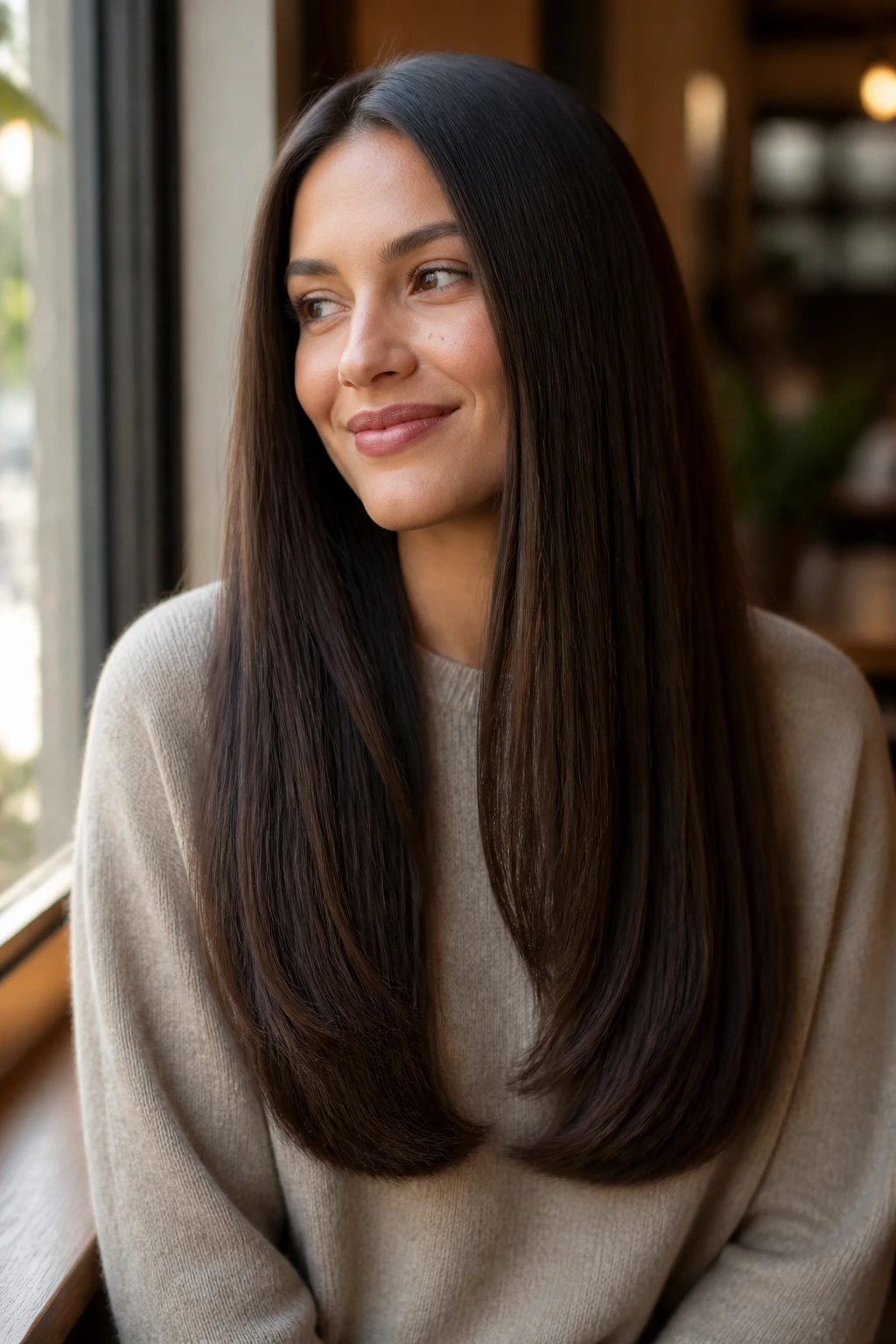
Why does a U-shape feel softer than a blunt cut even when the length stays long? Because the center hangs slightly longer while the corners round inward just enough to avoid that flat wall across the back. On thick straight hair, that little curve keeps the finish from looking boxy.
Ask Your Stylist For
- A long U, not a dramatic scoop.
- Corners that sit about 1 to 2 inches shorter than the center.
- A clean edge with only light point cutting at the very ends.
This cut works well if your hair hits the bra line or lower. The shape keeps the density, but it lets the hair drape instead of standing out at the shoulders. If you wear sweaters, collars, or high-neck tops, the U-shape slides over fabric better than a strict rectangle.
One practical detail: when thick hair dries, it often looks a little shorter than expected. Have the center measured after the hair is fully dry if you want the longest point to stay below the shoulder blades.
3. Long V-Shape
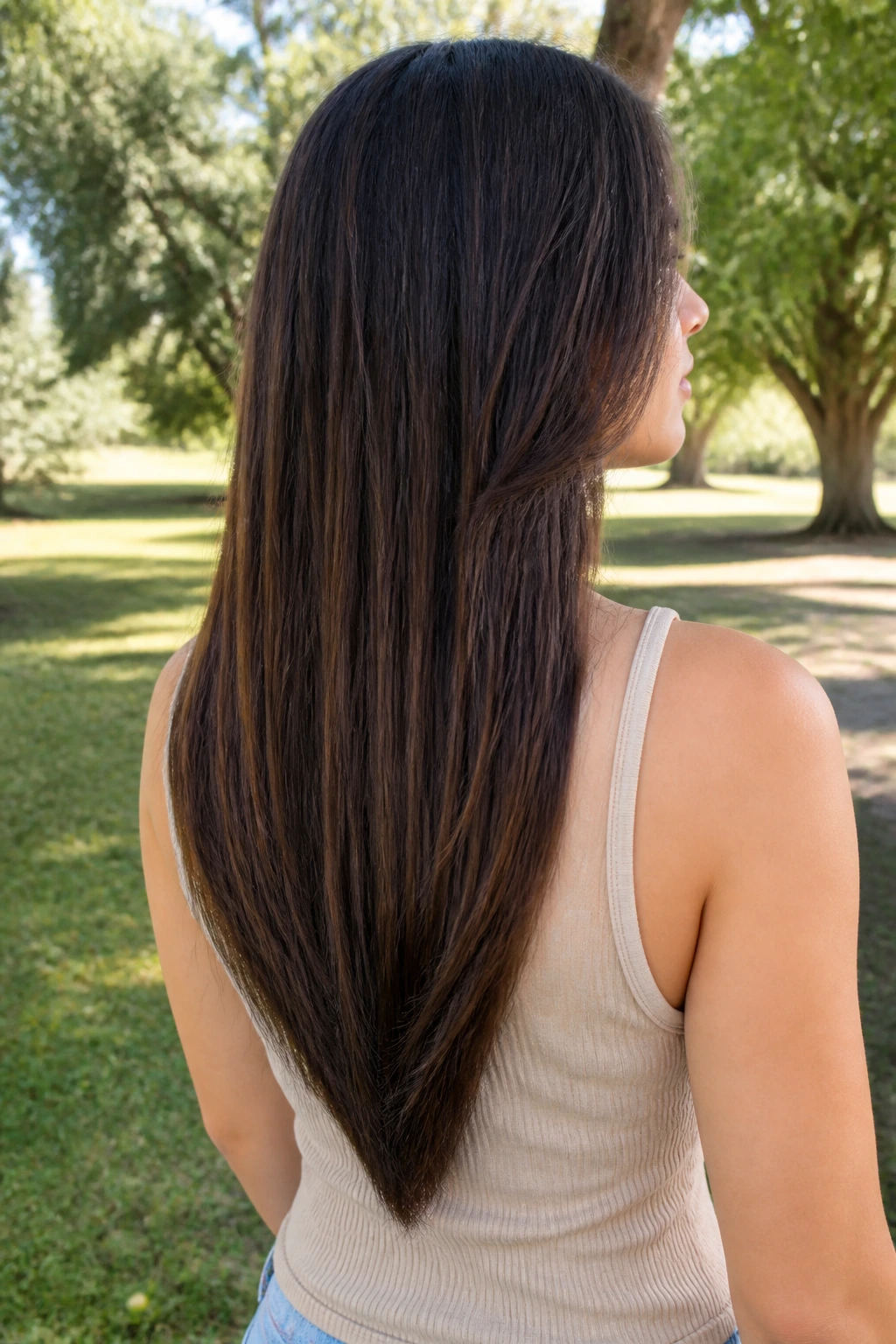
A V-shape gives thick straight hair a visible tail at the back, which can be a good thing if you like length with a little drama in the silhouette. The sides taper toward the center, so the overall outline feels lighter without losing the heavy, glossy curtain down the middle.
This cut works best when the V is kept subtle. If the angle is too sharp, the ends can look stringy, especially if your hair is dense but fine in diameter. Ask for a soft V that starts only a few inches above the hemline, not a steep point halfway up your back.
The V-shape is also one of the easiest ways to keep long hair from looking like one flat sheet from behind. It gives your stylist something to work with if you like half-up styles, because the back has a natural drop. If you love a ponytail, this cut also helps the gathered hair fall with a little more shape.
4. Invisible Internal Layers
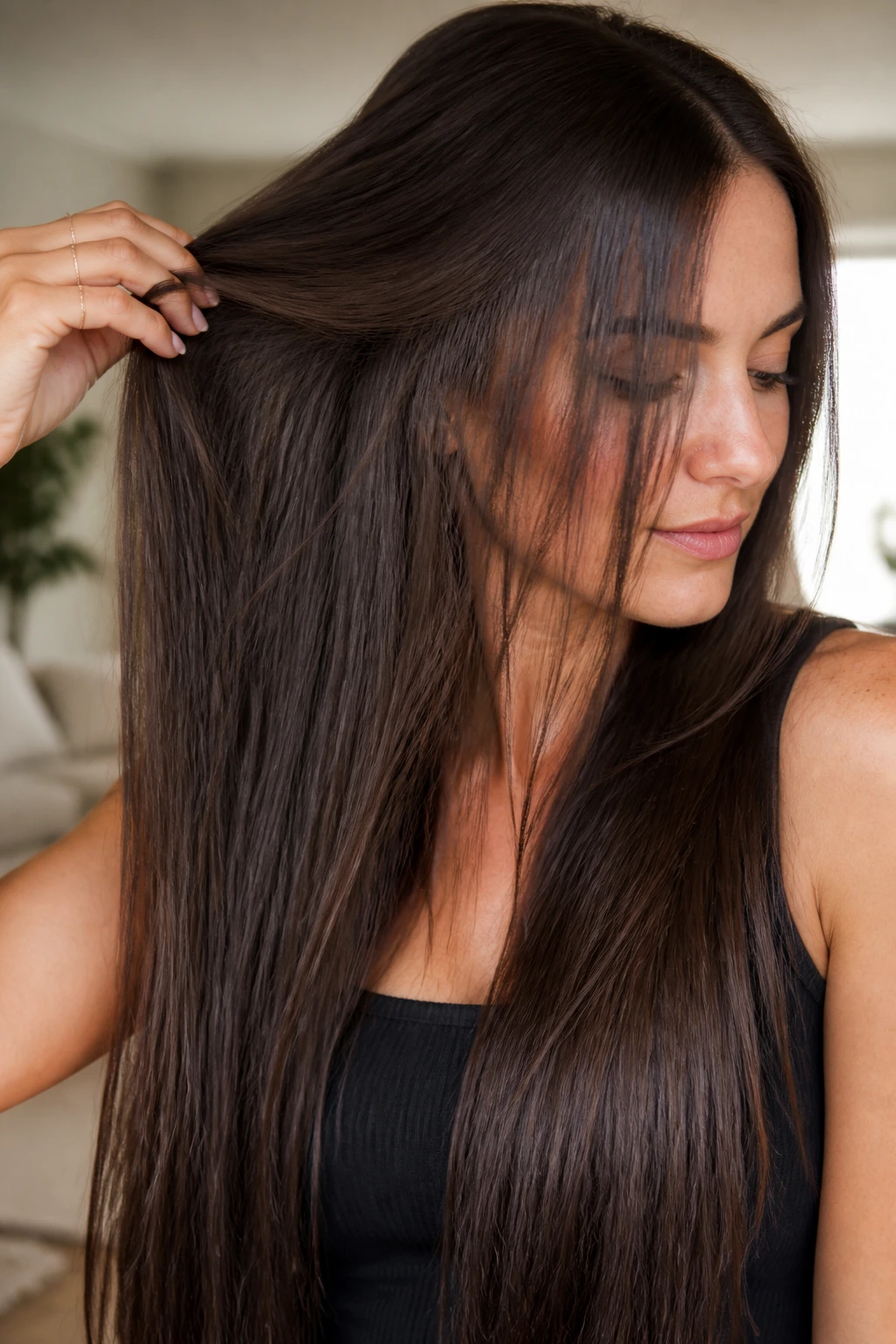
Invisible internal layers are the quiet fix for hair that feels like too much, without looking like it was obviously layered. The outer line stays long and smooth, while weight gets removed from underneath where the density builds up the most. You don’t see the layers at first glance. You feel them when the hair moves.
That’s the point. Thick straight hair often needs reduction, not decoration. Internal layers keep the visible perimeter intact, which is why the haircut still looks polished when it’s tucked, pinned, or worn dead straight. It’s the cut I’d pick for someone who wants their hair to look expensive in the most understated way possible.
The catch is that the interior work has to be careful. Too much internal texturizing and the hair starts collapsing in odd spots, especially around the midlengths. Ask for weight removal only in the densest zones, usually beneath the crown and around the back of the head.
5. Cheekbone-to-Collarbone Face Frame
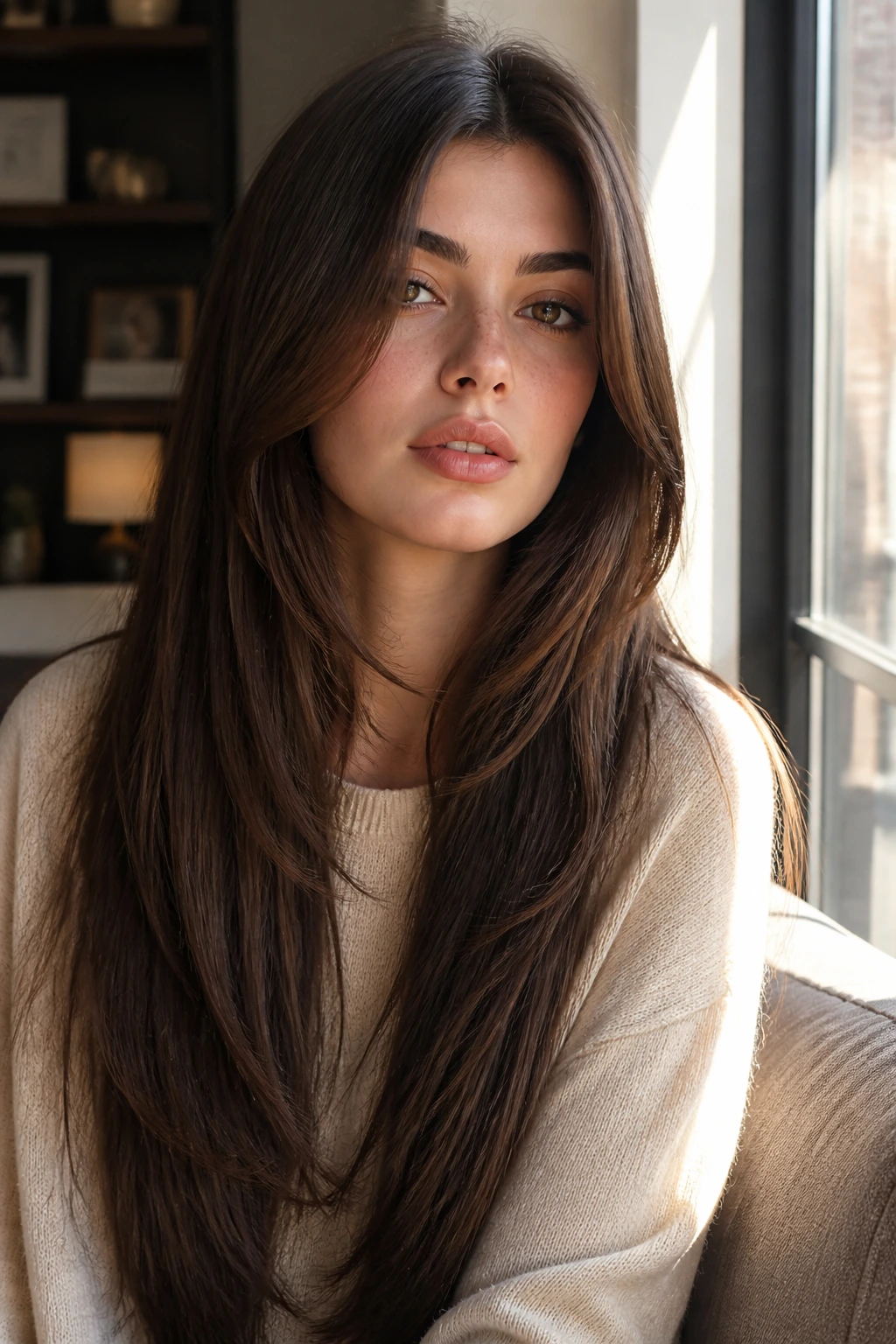
A face frame that starts near the cheekbone and falls to the collarbone can take a thick long cut from heavy to lifted in one appointment. It softens the front without stripping away the length you worked to keep. On straight hair, these pieces read clean and deliberate, not airy in a flimsy way.
Where the Shortest Piece Should Land
The shortest front piece usually works best around the cheekbone or just below it, but the exact point depends on your face shape and how much forehead you want to show. The longer front piece can skim the collarbone so the line doesn’t stop too abruptly.
This cut is good when the ends of your hair feel heavy but you don’t want a full layered look. It lets you tuck one side behind the ear and still have something framing the face. That front movement makes straight hair look less rigid.
Keep the rest of the haircut simple. If the front is already doing the work, the back does not need a bunch of extra layers competing with it.
6. Curtain Bangs With Clean Length
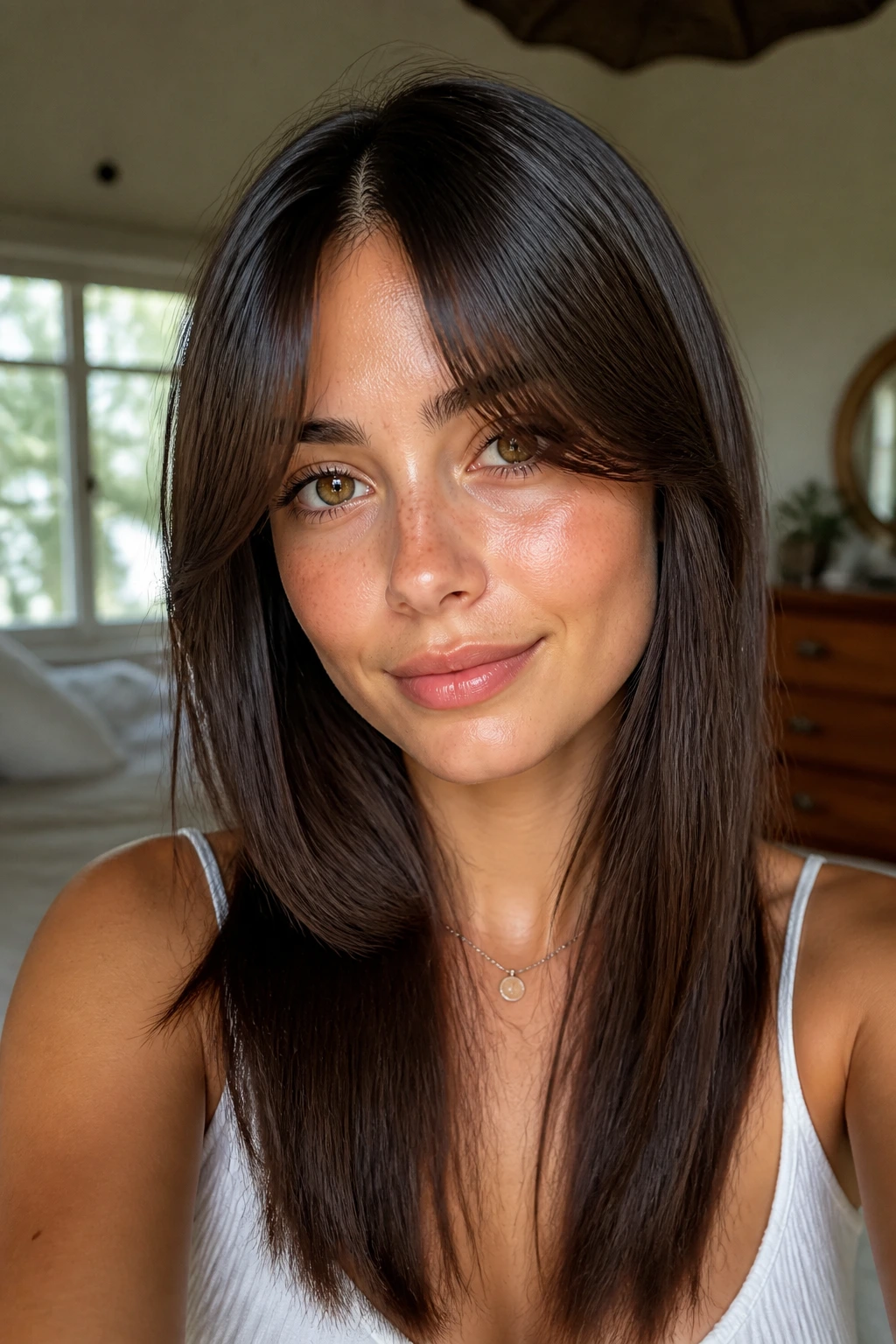
Curtain bangs are one of the few fringe styles that make thick straight hair feel lighter without turning the whole cut into a bang-heavy haircut. The center opens near the part, then the sides sweep out toward the cheeks. Because the bangs are split and longer at the edges, they sit more naturally on dense hair than blunt fringe often does.
The magic is in the blend. Thick hair can hold enough weight to keep curtain bangs from looking wispy, which means you get a soft frame without the ends going see-through. Keep the longest side pieces around jaw to collarbone length so the transition into the rest of the haircut feels smooth.
They do need a bit of upkeep. A quick re-trim every 4 to 6 weeks keeps the center from dropping into your eyes and keeps the sweep from losing its shape. If you hate daily styling, this is still manageable, but it is not zero-effort hair.
7. Bottleneck Bangs and Sleek Ends
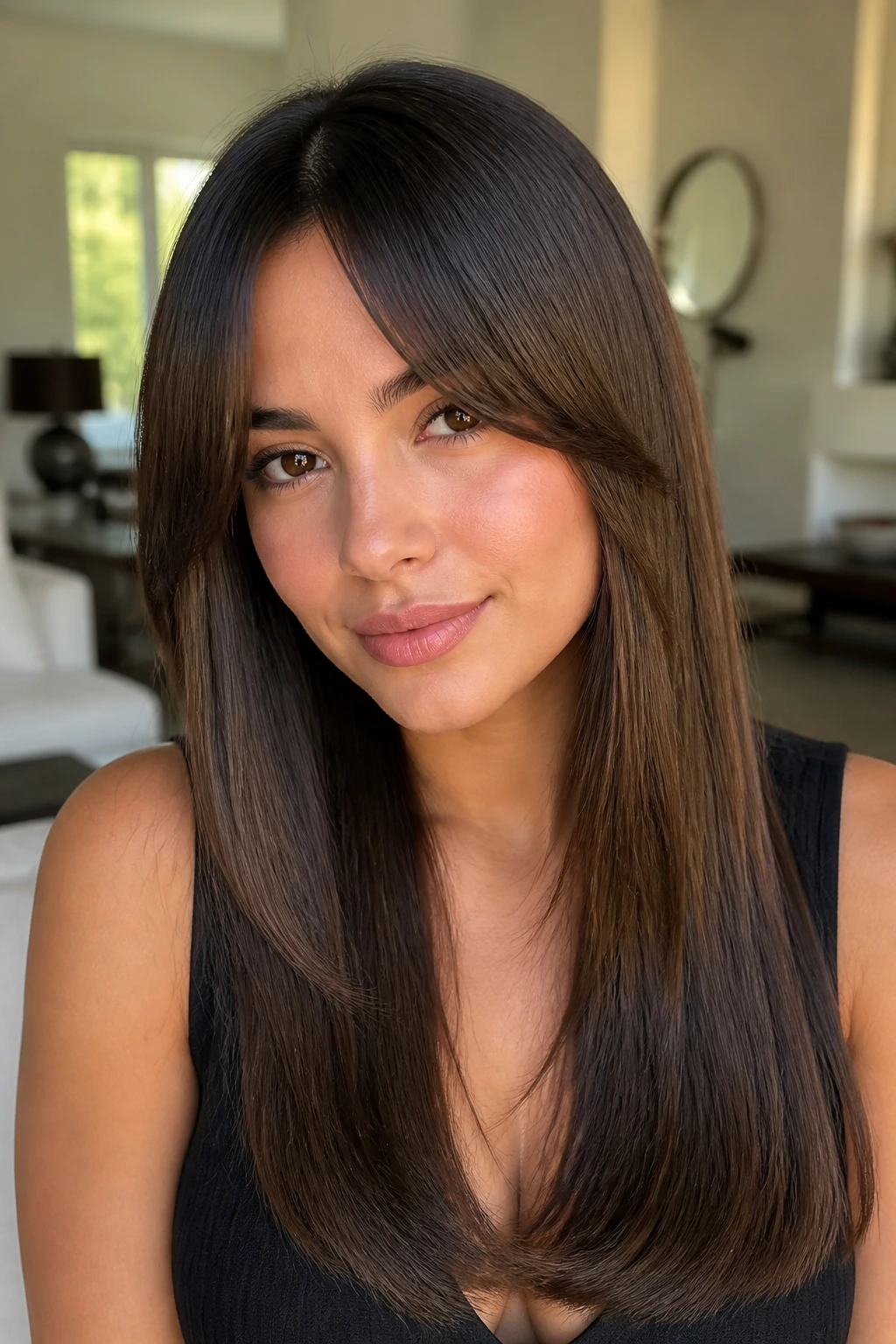
Bottleneck bangs are narrower in the center and wider toward the temples, which makes them a smart match for thick straight hair that needs a little face work without a full heavy fringe. The shape lets the bangs sit flatter, and the longer sides blend into the length instead of standing apart from it.
They’re especially good if you wear a center part and want the front to feel intentional. The center section usually starts shorter, then the outer pieces are left longer so the whole thing opens like a narrow bottle neck. It looks cleaner on dense hair than a short, blunt bang because there’s room for the thickness to settle.
I’d skip this if your hairline has a strong cowlick right at the front. That can split the center and make styling annoying. Otherwise, it’s a tidy, modern way to add shape without giving up the long silhouette.
8. Side-Parted Long Layers

A side part changes the whole mood of thick straight hair before the scissors even finish. It shifts the weight across the forehead and breaks up the straight-down curtain that can make dense hair feel flat on top and heavy at the ends. Add long layers, and the haircut starts moving instead of sitting.
Why It Stops the Triangle Look
The triangle effect shows up when all the bulk hangs below the shoulders and the top looks narrow by comparison. A side part helps because it creates lift on one side and gives the layers a place to fall. Keep the shortest layer below the chin if you want the shape to stay long and controlled.
This cut works well for anyone who wants a softer front without committing to bangs. The side sweep can be tucked behind the ear, pinned back, or left loose after a blowout. It’s flexible in a way a blunt center-parted cut is not.
If your hair falls dead straight with almost no bend, ask for the layers to be long enough to keep the ends full. Too many short steps and the shape loses its weight.
9. Rounded Shoulder-Skimming Layers
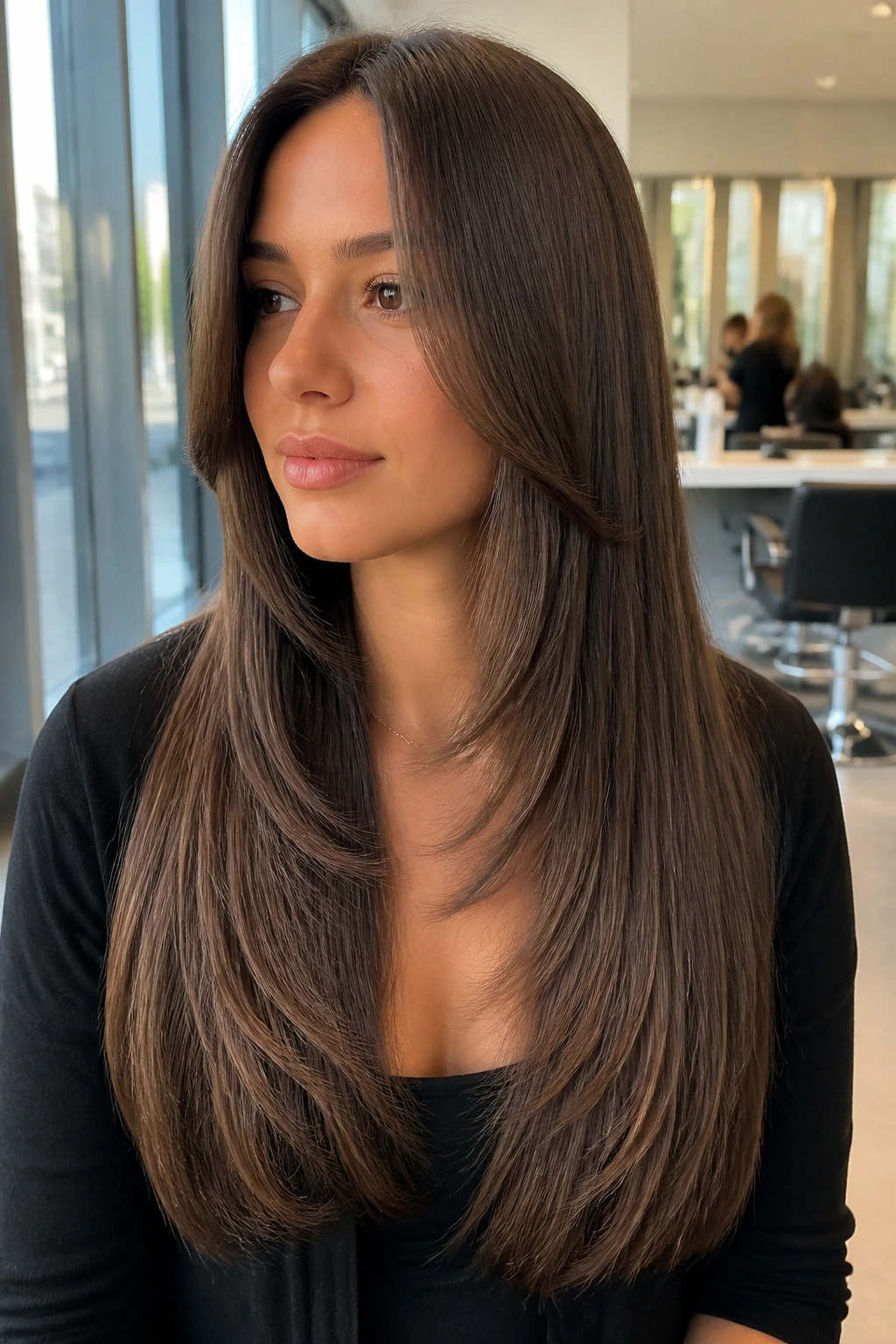
Rounded layers are quieter than a shag and softer than a blunt hem. They arc around the shoulders, which is useful if your thick straight hair tends to kick outward at the collarbone. The curve tells the ends where to go.
The cut works because the shape follows the body instead of fighting it. Hair that sits past the shoulders often flares out where it hits the shirt, especially if it’s dense. A rounded outline keeps that edge from turning square.
This is one of the best options if you like to wear your hair down most of the time and want movement that still looks controlled. The layers should be long enough that the bottom remains full. If the shortest pieces land too high, the shape starts looking busy instead of rounded.
10. Butterfly Layers on Straight Hair
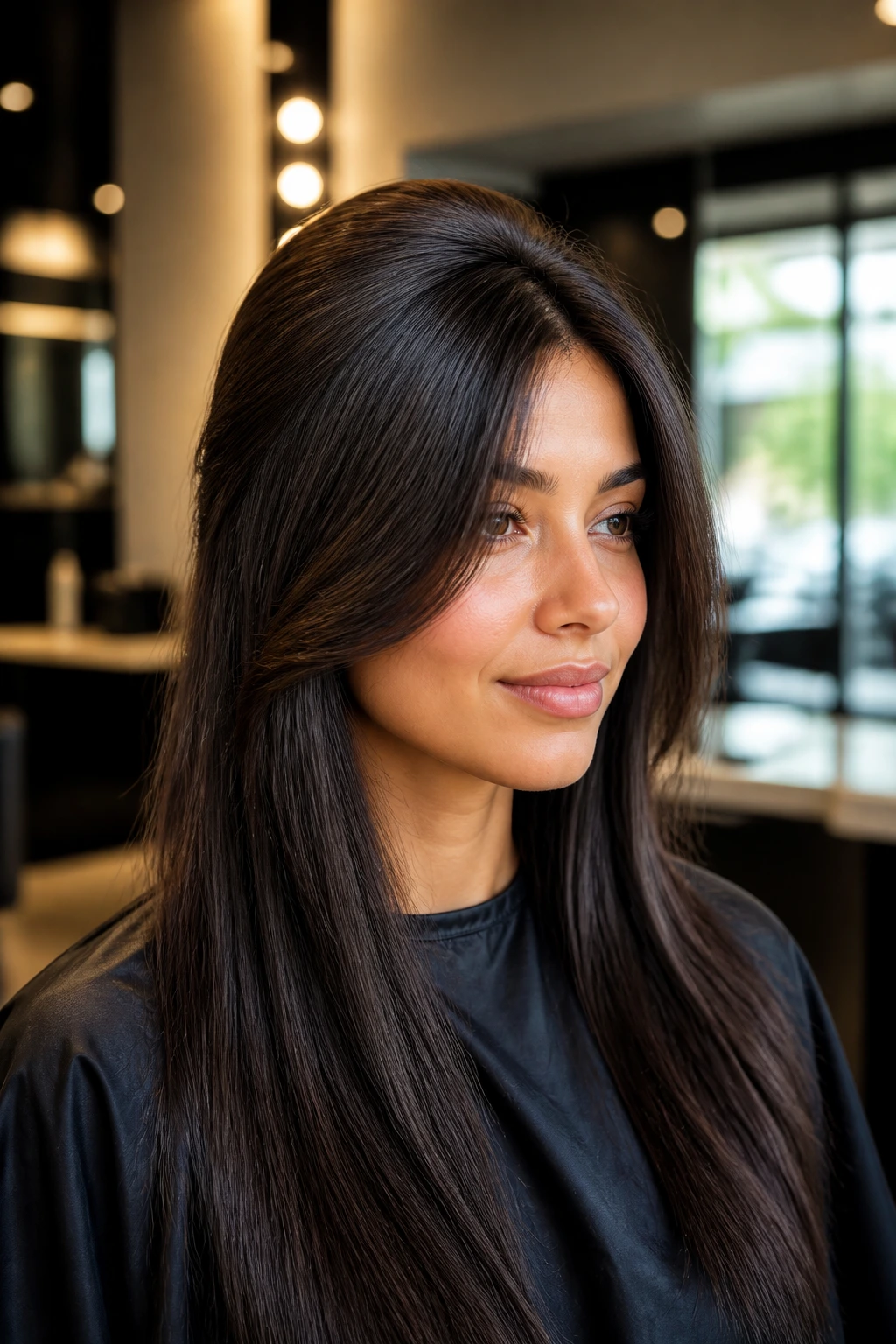
Butterfly layers can be a little theatrical on paper, but on thick straight hair they make practical sense. The shorter face layers give you lift around the cheekbones, while the longer back layers keep the length heavy and glossy. It’s a two-tier cut, and that split is exactly why it works.
A good butterfly cut on straight hair should not look chopped up. The top layer usually starts around the chin or cheekbone, then gradually blends into the longer length. The result is movement around the front without sacrificing the weight that makes thick hair hang nicely.
If you like a blowout, this is a strong pick. The short pieces frame the face when brushed away, and the longer pieces keep the finish from collapsing. Just don’t let anyone over-layer the back. The whole point is contrast, not thinness.
11. Shag-Lite Long Layers
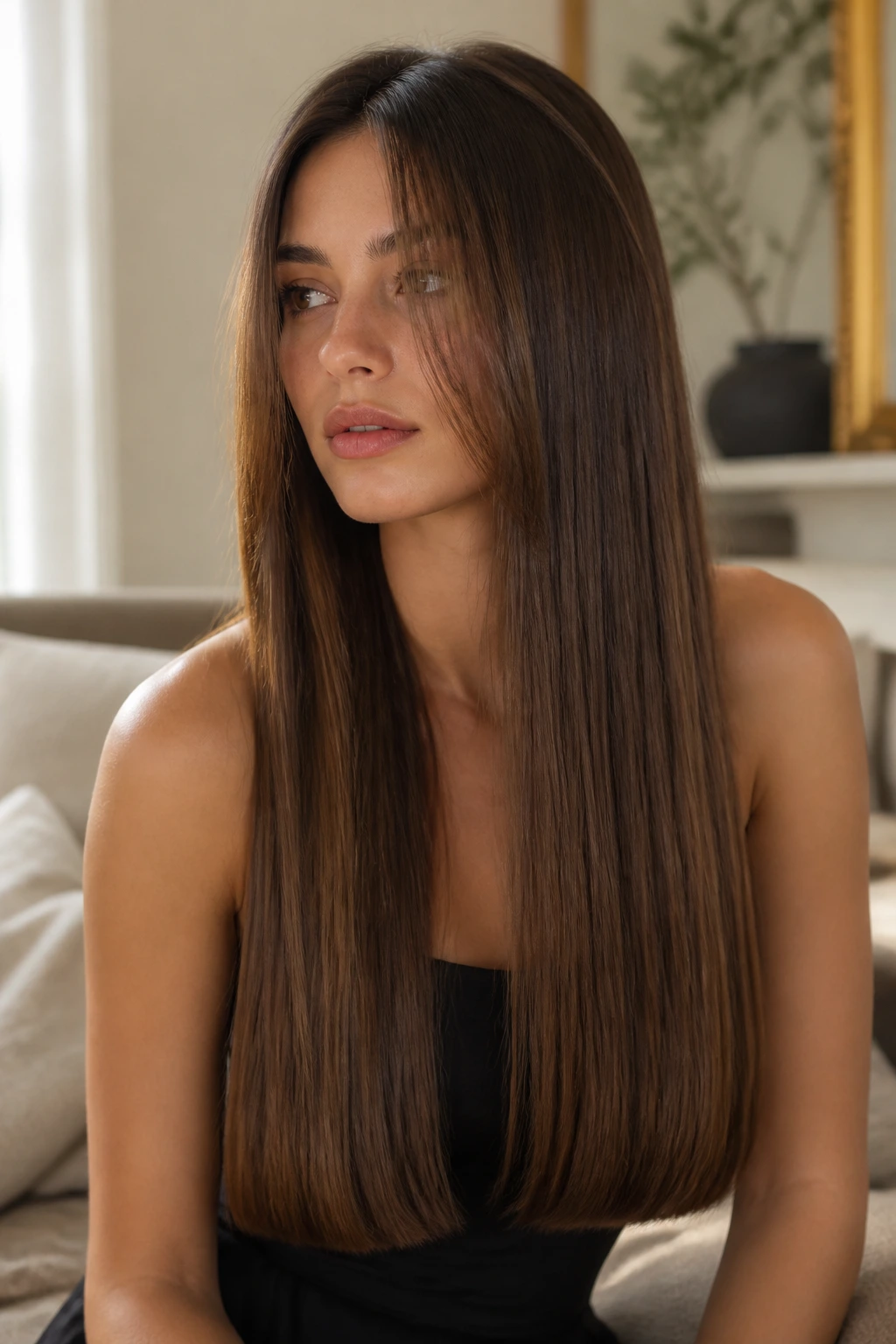
A shag-lite cut borrows the movement of a shag without the heavy texture overload. On thick straight hair, that balance matters. You get long layers, some broken-up edges near the front, and a bit of separation through the midlengths, but the shape still reads as long hair first, shag second.
This is a good choice if you want the hair to move when you turn your head. Straight hair can look stiff when every strand is the same length. A shag-lite cut breaks that stiffness up without making the ends look shredded.
Keep the texturizing concentrated near the crown and front. If the ends are thinned all over, the haircut loses its weight and starts to puff. I’d ask for a light hand here. Thick hair can handle movement, but it can also eat a bad razor job for breakfast.
12. Underlayer Debulking Cut
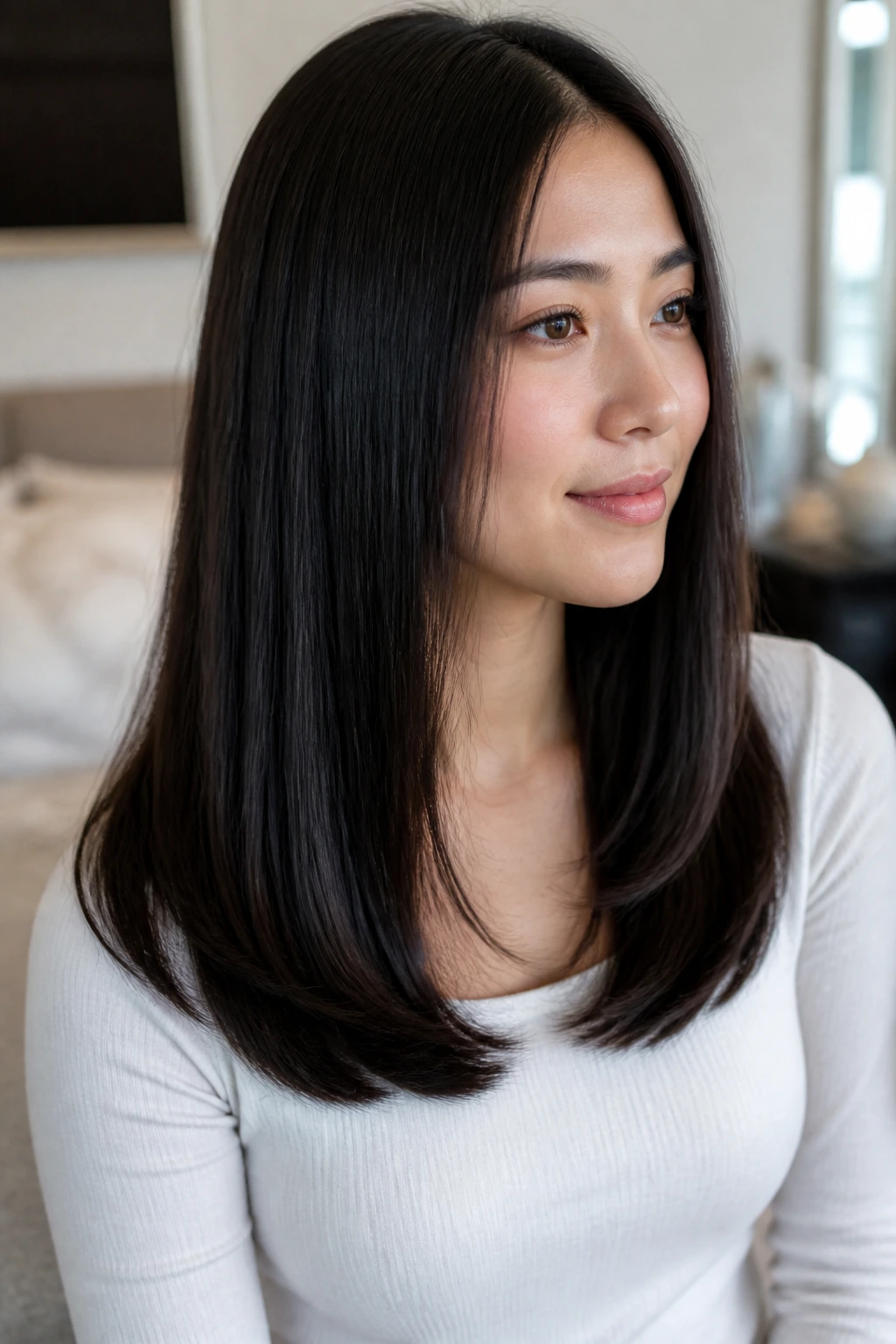
Why does internal debulking work better than slicing away at the surface? Because the outline stays intact while the hidden bulk comes out from underneath. Thick straight hair often gets heavy in the back and under the ears, and that’s where a careful debulking cut earns its keep.
Unlike a layered cut that changes the silhouette, this one keeps the outside line long and tidy. The stylist works inside the shape, usually beneath the top veil, so the head feels lighter without looking stripped. That’s a good move if you love straight hair but hate the way it swells into a wide shape by midday.
Ask for the bottom perimeter to stay thick. If the weight gets removed from the last inch or two, the whole haircut can look flimsy. The trick is control, not subtraction for its own sake.
13. Feathered Front Corners
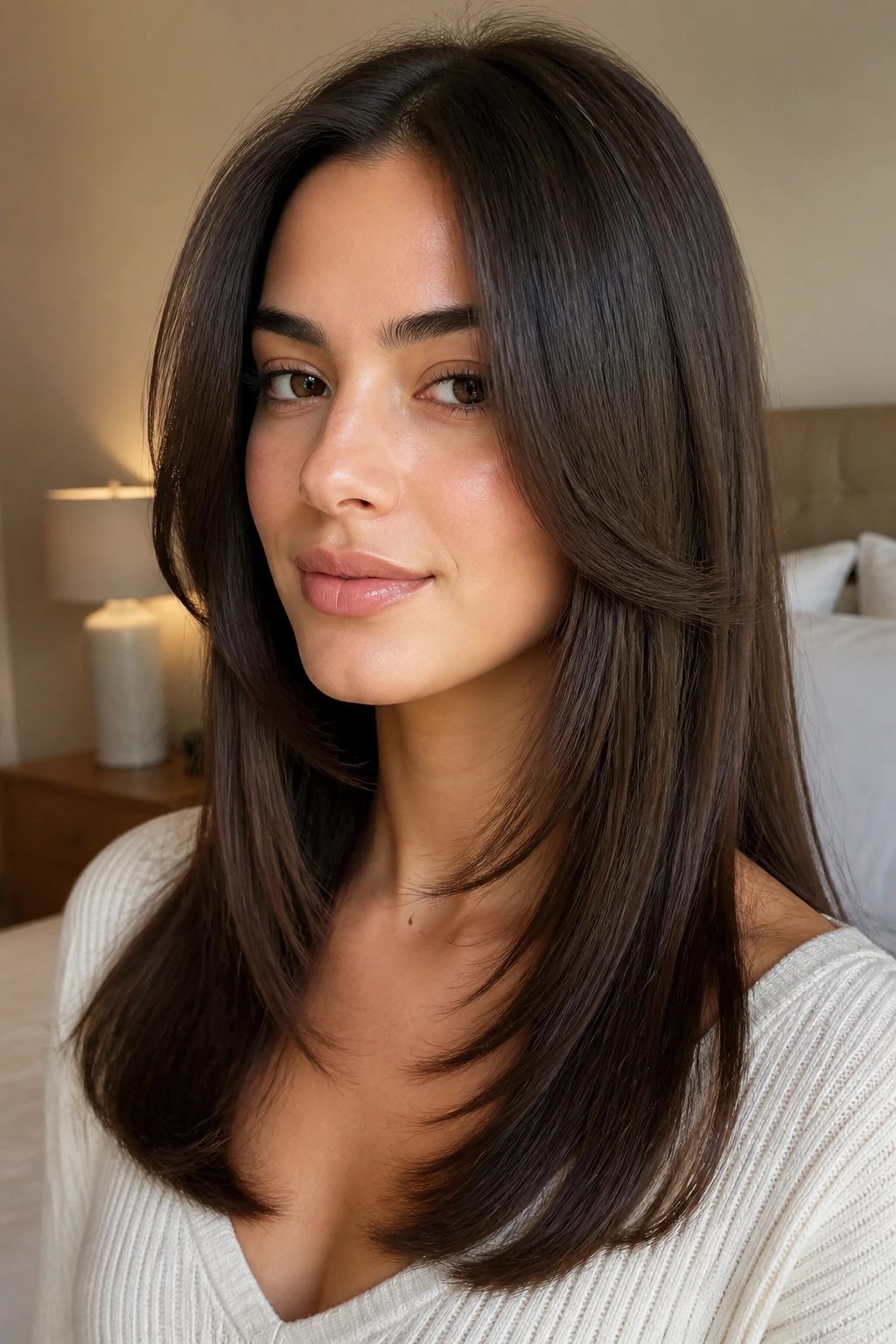
The front corners are where thick straight hair gets stubborn. They hang heavy, hit the collarbone, and then decide to sit like a wall. Feathering just those corners softens the edge without turning the whole haircut into a layered cloud.
This cut works especially well if you wear your hair forward a lot or tuck it behind one ear. The feathering lets the front move with the jawline instead of staying flat and square. Keep the feathering light and low, usually from cheekbone to collarbone, so the length still looks dense.
If your hair is coarse, feathering can help the front bend a little more easily with a brush. If it’s fine but dense, keep the feathering minimal. Too much and the ends go thin fast.
14. Center-Part Perimeter Cut
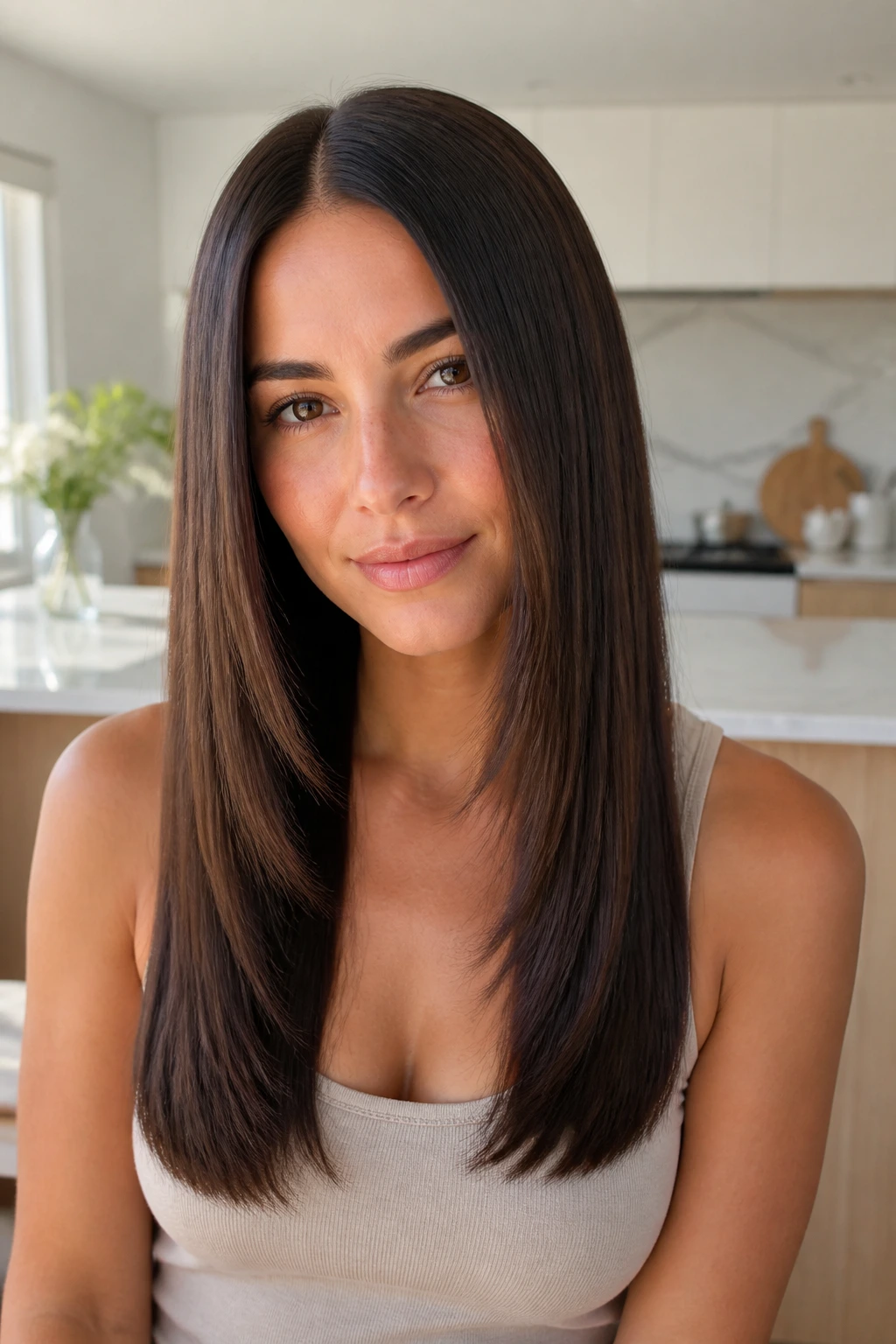
A center part and a clean perimeter make a strong pair on thick straight hair. The symmetry makes the density look deliberate, and the straight edge keeps the bottom from spreading. If you like polished hair that does not need a lot of fuss, this is one of the safest bets.
How to Keep It from Looking Severe
Add only a touch of softness around the face. A tiny face frame, maybe 1 to 2 inches shorter than the rest, is enough to stop the haircut from feeling too hard. The rest should stay one line.
This cut is especially useful if you wear your hair down more often than up. The even part and the straight edge make the whole head read clean from the front and the back. It also grows out with less drama than a heavily layered style.
A small warning: if your cowlick pushes the part around, ask the stylist to map the part while the hair is wet and then check it dry. Thick hair can hide a crooked part until you’re already home.
15. Tapered Ends With Soft Movement
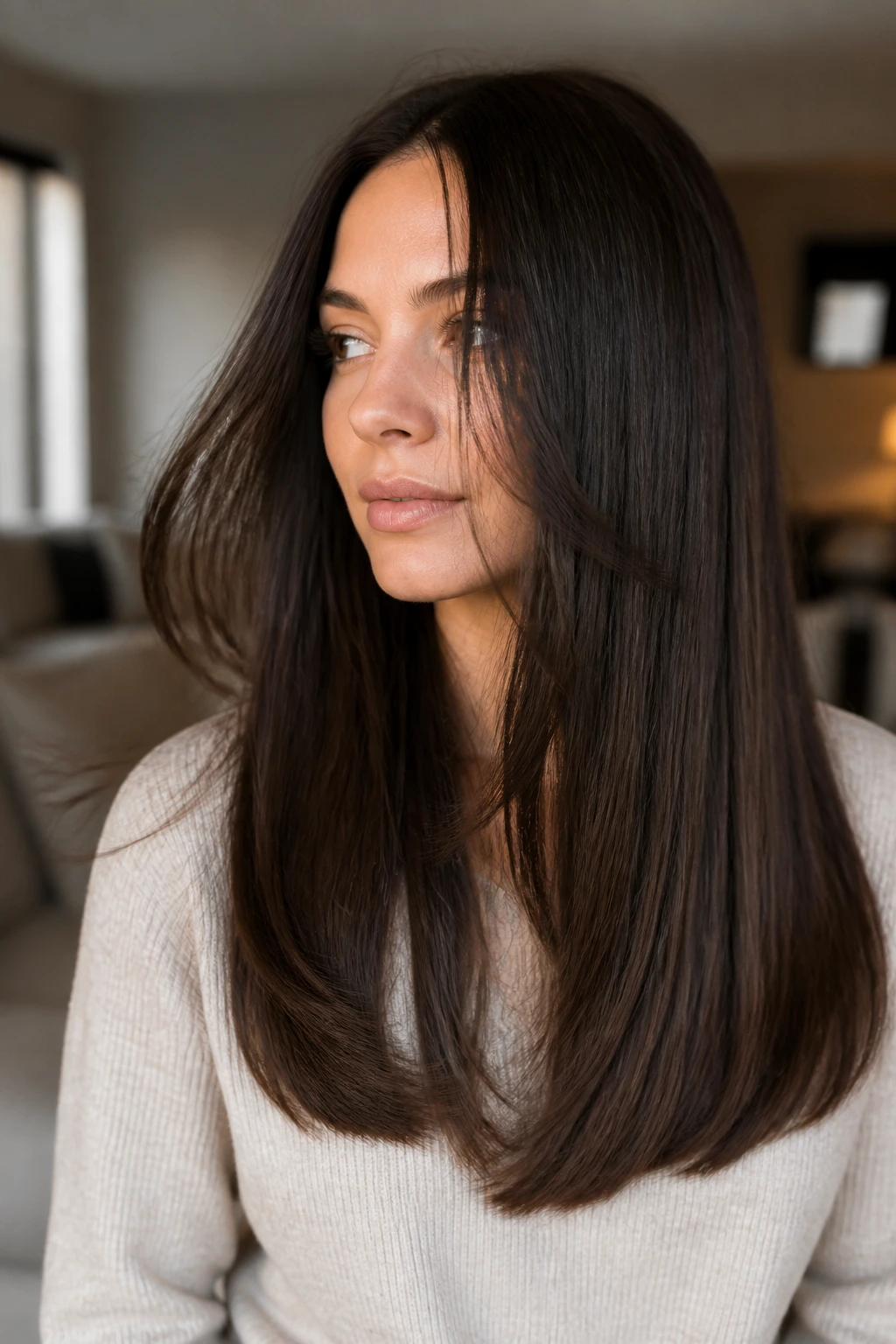
Tapered ends are a good answer when thick straight hair feels too blunt at the bottom but you don’t want obvious layers. The last inch or two is softened slightly so the hemline stops looking like a hard shelf. It still has weight. It just moves a little easier.
The best version is subtle. You want the edge to narrow just enough that it falls under naturally, not so much that the ends look frayed. This is especially useful if you like a flat iron finish with a slight bend at the bottom.
Keep the taper low. If the stylist starts carving too high, the whole cut loses its body and starts to look uneven. Thick hair can take a little softening, but it needs a solid base.
16. Heavy Fringe and Long Length

A heavy fringe sounds bold until you see what thick hair can do with it. Dense strands actually help a full fringe sit down cleanly, which means you can add forehead coverage without dealing with see-through gaps. Paired with long length, the contrast can look sharp.
The important part is balance. A thick fringe needs long layers or a heavy perimeter to keep the haircut from turning into bangs plus a wall of hair. If the rest of the cut is too light, the fringe takes over. Keep the longest side pieces long enough to melt into the rest of the length.
This style does need regular bangs trims. Every 3 to 4 weeks is about right if you want the fringe to stay above the lashes and not split at the center. Dry shampoo helps, but bangs still behave better when they’re freshly trimmed.
17. Slide-Cut Length
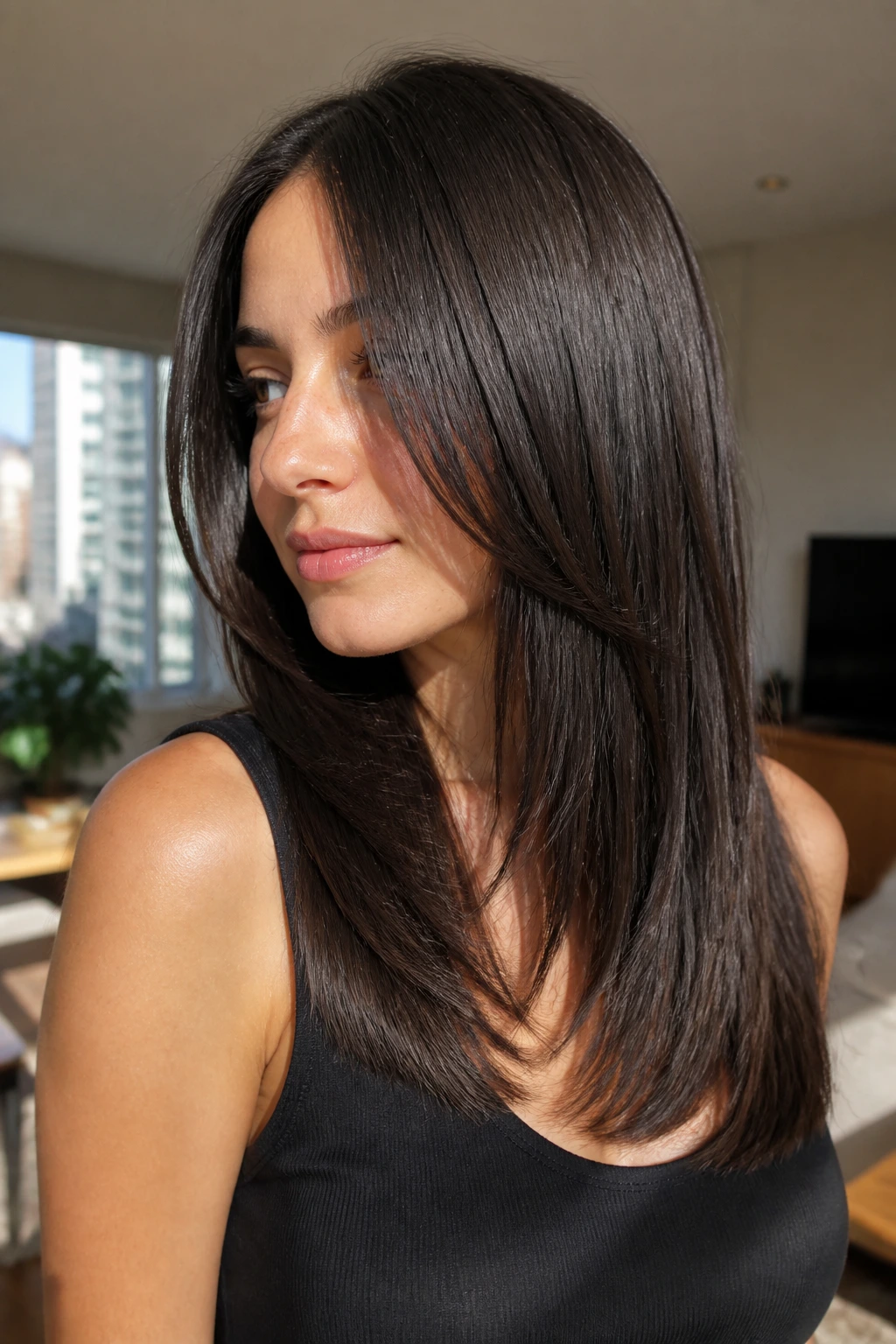
Slide-cutting can be a gift or a mess, depending on who does it. On thick straight hair, though, it can carve out just enough movement through the midlengths without making the perimeter disappear. The blade glides along the hair shaft and removes a little weight at a time.
What Makes It Different
Unlike blunt cutting, slide-cutting softens the transition between top and bottom. That means the hair moves more when you turn your head, but the ends still look full. It works best if you want a lived-in finish rather than a crisp line.
I’d only use this approach on hair that is genuinely dense. Fine straight hair can lose too much body from it. And because the technique depends on control, it should be light around the ends. A heavy hand here leaves uneven gaps that show every time the wind hits.
18. Waterfall Layers
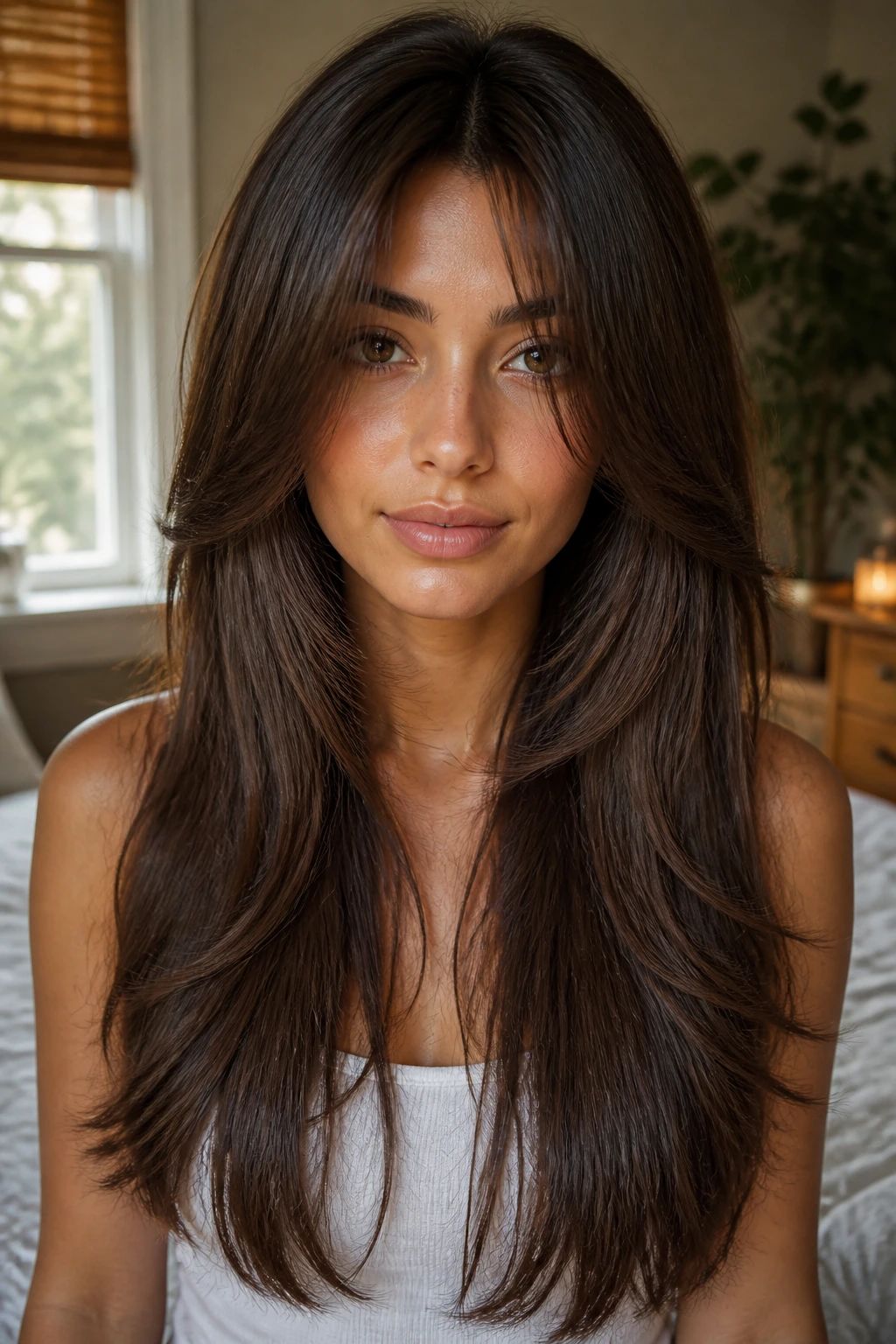
Waterfall layers fall in sequence, short to long, like the name suggests. On thick straight hair, they create a soft cascade without the stacked, choppy look that can happen when layers are cut too aggressively. The hair still feels long. It just has more shape while it moves.
This is a good style if you want your hair to fall around the shoulders instead of sitting as one single block. The longer pieces help the ends stay full, and the shorter pieces near the front keep the whole thing from going limp. It’s a shape you can blow out smooth or wear with a slight bend.
Ask for only a few visible steps. A waterfall cut should read as gradual, not stair-stepped. Too many layers turn the finish busy, and thick hair already has enough going on.
19. Deep Side Sweep With Long Sides
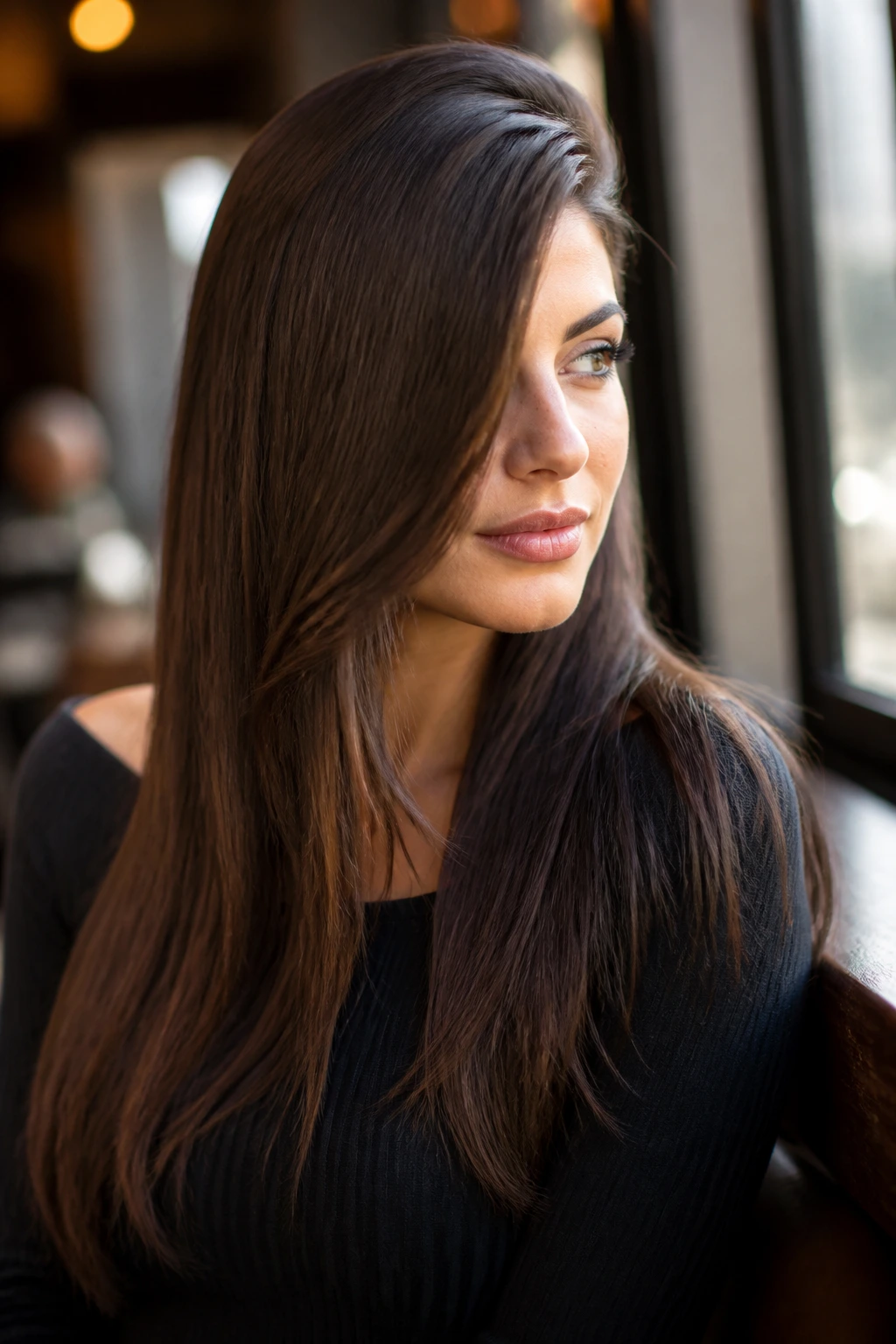
A deep side sweep changes the face of thick straight hair without needing bangs. The sweep pulls weight to one side, gives the roots a little lift, and leaves the opposite side clean. Long side pieces keep the haircut from feeling lopsided.
This cut is useful if you like to pin one side back or wear big earrings. The long sweep draws the eye across the face and keeps the length intact. It also gives you a built-in styling trick on days when your hair refuses to cooperate — just shift the part and let the front pieces do their work.
Keep the side sweep long enough to tuck. If it’s too short, it sticks out awkwardly instead of blending. A good sweep should move with one pass of a brush, not three.
20. Polished One-Length Dusting Cut
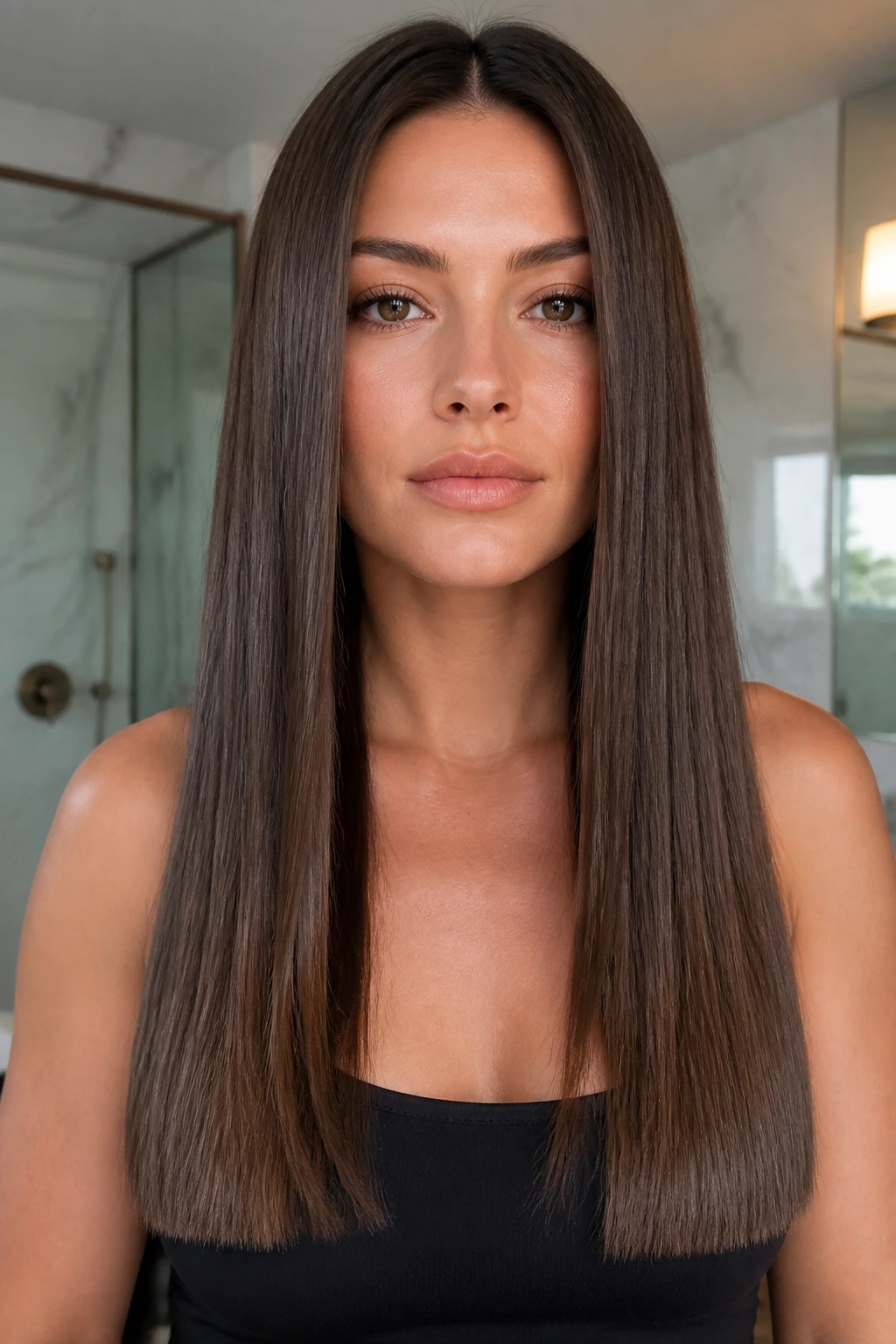
What makes a one-length dusting cut different from a regular trim? The answer is tiny, and that’s why it matters. You keep the same long shape, but every 8 to 10 weeks the ends get a very small dusting — often only 1/4 inch — so the line stays sharp and the hair doesn’t split.
This is one of the best cuts for people who love maximum length and do not want layers competing with the thickness. Thick straight hair can look luxurious when the bottom edge is even and the ends are sealed. The line matters more than the idea of “movement.”
If your ends start flipping or looking see-through, don’t wait for a major cut. Dusting protects the shape before the damage becomes obvious. It’s not glamorous, but it keeps the haircut honest.
21. Hidden Underlayers and a Glossy Top Veil
Hidden underlayers are for hair that feels heavy at the neck and under the ears but still looks good when the top layer stays smooth. The visible top veil remains long and glossy, while the underneath gets just enough relief to stop the whole shape from ballooning.
This works especially well on very dense hair. You get less bulk without the obvious choppiness that some layered cuts create. The top layer hides the internal work, so from the outside the haircut still reads as long and clean.
The only rule here is restraint. If the underlayers are cut too high or too wide, the top starts collapsing and you can see the difference through the length. Hidden work should stay hidden.
22. Soft C-Shape Perimeter
A C-shape perimeter curves inward slightly at the ends, more like a soft bend than a dramatic scoop. On thick straight hair, that tiny inward shape can make the whole cut fall better around the shoulders and collarbone. It’s subtle. That’s the point.
This is the haircut for someone who likes a clean line but wants the ends to tuck under a little with minimal effort. A round brush or a quick pass with a flat iron can set the curve in place. If the curve is cut well, it falls that way even on lazy days.
The C-shape also keeps thick hair from looking too squared off in profile. It’s one of those cuts that seems minor until you see it in motion. Then it makes sense fast.
23. Razor-Touched Ends
Razor-touched ends are not for every head of hair, and I’d rather be blunt about that. On coarse thick straight hair, a light razor finish at the last 2 to 3 inches can soften the edge and help the hair move. Used badly, it frays the ends and makes them look dry even when they’re not.
Best When You Want Less Stiffness
If your hair feels almost too strong to bend, a careful razor touch can take the edge off. It works best when the stylist uses a very light hand and stops before the whole hem loses its line. The goal is texture at the bottom, not a shredded finish.
Skip this if your hair already frizzes at the ends. Razor work exposes that problem fast. A point-cut or blunt finish will usually serve you better. This is one of those techniques that looks easy and isn’t.
24. Lower Nape Shelf Cut
A lower nape shelf cut keeps the weight low in the back and lets the top flow over it. On thick straight hair, that can stop the whole head from puffing at the crown while still giving you a solid bottom line. It’s a practical shape for people who wear hair tied back part of the time.
The shelf gives the hair somewhere to sit. That matters more than people think. Dense hair often feels too wide when everything is cut to the same level, especially if the neck area is bulky. By keeping the weight concentrated lower, the cut feels easier to tuck and pin.
It’s not the softest silhouette on this list. It does look structured. If you like neat, contained hair rather than airy movement, that structure is the charm.
25. Graduated Front Pieces
Graduated front pieces start long and step down in small increments around the face. On thick straight hair, that gradual drop stops the front from looking like a curtain with no shape. You still keep length. You just gain a better frame.
This cut is useful if you like to wear hair forward but don’t want traditional bangs. The pieces can hit the jaw, then the collarbone, then merge into the rest of the length in small steps. That spacing helps the haircut feel intentional instead of accidental.
Ask for the graduation to stay subtle. Big jumps in length create a choppy look that thick straight hair does not need. Small changes read cleaner and grow out better.
26. Airy Crown Lift
Can thick straight hair get lift at the crown without turning the rest of the cut into a mess? Yes, if the layers are kept high and very controlled. Airy crown lift means the top gets just enough removal to stop the roots from sitting flat, while the length stays heavy below.
This is a smart choice if your hair collapses at the scalp but poofs at the ends. The crown work gives the silhouette some height, which makes the length below look sleeker by comparison. A little lift goes a long way.
Do not overdo it. Crown layers that are too short show quickly on straight hair, and the top can end up looking thin from the side. The best version is almost invisible until you move.
27. Minimal Layers With a Thick Hem
Minimal layers are for people who want long, straight hair to look full all the way through. The hem stays thick, the front gets only the lightest framing, and the overall feel is dense in the best sense of the word. It’s a quiet haircut, but it is not a lazy one.
This is one of my favorite options for coarse straight hair because the ends keep their weight. Thick hair often looks better when it has a substantial bottom edge and only a touch of shape near the face. Too many layers make the silhouette chatter. A thick hem settles it down.
The tradeoff is movement. You won’t get much of it unless you style the ends with a bend. If you care more about fullness than swing, that trade is easy.
28. Underbevel Length
An underbevel length cut curves the bottom slightly under so the perimeter does not stick straight out from the shoulders. On thick straight hair, that tiny inward bend can make the whole haircut feel more controlled. It’s a small adjustment with a big visual payoff.
This is a strong choice if your hair flares when it reaches your collarbone or chest. The underbevel keeps the outline close to the body and helps long hair move past clothes instead of catching on them. It also pairs nicely with a round-brush blowout, because the shape is already working in your favor.
If you want the ends to look sleek, not fluffy, this is a good final shape to ask for. Keep the bevel subtle. A hard undercurve can look dated; a soft one just looks neat.
Why the Weight Line Matters More Than the Trend Name
People get hung up on labels — blunt, layered, shag, butterfly — but thick straight hair cares more about the weight line than the name on the cut sheet. If the perimeter is too light, the ends drift apart. If the top is too heavy, the crown flattens while the sides balloon. The haircut has to answer both problems at once.
That’s why a good stylist talks about density, not just length. Thick hair can feel coarse, silky, heavy, springy, or all four at once. The right cut respects where your hair naturally collapses and where it naturally expands. Most of the fight happens at the shoulder line and the ends. That’s where the shape should be decided.
Straight hair also shows every mistake in the outline. There’s no wave pattern to hide a choppy step or a crooked hem. A clean line, even if it’s softened a little, does more work than an overtextured cut ever will.
The smartest approach is usually to remove bulk from inside the shape, not tear apart the shape itself. That one decision changes everything. It’s the difference between hair that sits down and hair that keeps trying to fan out around your face.
The Tools That Make Thick Hair Behave
A good cut starts with good tools, and thick straight hair is not the place to improvise with dull scissors and a random brush from a drawer.
-
Sharp haircutting shears: Dull blades crush thick ends and leave them ragged, so sharp shears matter more than most people think.
-
Tail comb: A fine tail comb helps section dense hair into clean panels, especially at the crown and nape.
-
Sectioning clips: Thick hair needs more than two clips. Use sturdy duckbill or alligator clips so the sections stay put while you work.
-
Spray bottle: Light misting keeps straight hair manageable during cutting without soaking it into a slick, hard-to-see sheet.
-
Blow dryer with nozzle attachment: The nozzle directs airflow downward, which helps the cut sit flat instead of puffing.
-
1.25-inch round brush: This size gives a gentle bend without overcurving long lengths.
-
Flat iron with rounded plates: Useful for checking how the haircut falls when fully smooth; rounded plates leave a softer edge.
-
Heat protectant: Thick hair takes heat well, but it still needs protection if you regularly straighten the ends.
-
Light serum or cream: A pea-sized amount tames flyaways on the last 3 to 4 inches without making the hair greasy.
-
Wide-tooth comb: Better than tugging a dense mane with a narrow brush when the hair is wet or loaded with conditioner.
How to Tell a Stylist Exactly What You Want
Bring photos, yes, but do not stop there. Photos show shape; your hair tells the stylist how that shape will behave on your head. Thick straight hair needs a plain-language briefing: where it puffs, where it lays flat, where the ends kick out, and how much time you’re willing to spend styling.
Use real descriptions. Say, “My hair spreads out at the shoulders,” or “The bottom gets wide after a few weeks,” or “I want the length to stay thick at the ends.” That is more useful than asking for something “soft” and hoping everyone means the same thing. Soft can mean face-framing layers, or a bevel, or heavy debulking. Those are not the same haircut.
If you wear a center part every day, say that. If you tuck your hair behind one ear all the time, say that too. Those little habits decide where the front pieces should land. A haircut that looks good only in the salon chair is not much use.
One line I’d keep handy: “Keep the perimeter full, but remove bulk inside the shape.” That phrase tells a stylist you want structure, not random thinning. It’s the cleanest way I know to ask for thick hair that behaves without losing its long silhouette.
How These Cuts Wear With Parts, Accessories, and Necklines
Presentation: Straight long haircuts show best when the part matches the cut. A blunt hem looks sharp with a center part, while face-framing layers and side parts create a softer diagonal line. If you want the haircut to read clearly, tuck one side behind the ear and let the front pieces fall forward.
Accessories: Long straight hair takes clips, barrettes, and simple headbands better when the cut has some front shape. Curtain bangs, side sweeps, and graduated front pieces make room for metal clips at the temple or a narrow barrette. Heavy fringe pairs better with minimal earrings; otherwise, the front gets crowded.
Best Pairings: Higher necklines can make very blunt long hair feel even heavier, so open collars, V-necks, and square necks tend to show the shape better. If the haircut has a strong hem or a V-shape, the neckline can echo that clean line. If the cut is layered around the face, a softer neckline keeps the whole look balanced.
Where It Fits: Sleeker cuts like blunt hems and center-part perimeters work for formal settings because they stay tidy. More textured options — shag-lite, waterfall layers, or butterfly cuts — bring more motion when you want the hair to feel less rigid. The haircut sets the tone. The styling just follows it.
Practical Ways to Keep the Shape Clean
Thick straight hair rewards small, boring habits. Not glamorous. Effective.
Heat Direction: When you blow-dry, point the nozzle downward from roots to ends. That closes down the surface and keeps the hair from blooming into a halo at the top. Use medium heat and a final cool shot if your dryer has one.
Serum Rule: Use only 1 to 2 drops of serum on dry ends, and keep it off the roots. Thick hair soaks up more product than fine hair, but too much still makes the front pieces collapse.
Sectioning Matters: Straighten or smooth the hair in 1.5-inch sections, not huge slabs. Thick hair looks cleaner when each pass is controlled. Big sections leave the underlayer untouched, and that’s where the puff starts.
Trim Rhythm: If you wear the hair long and straight, trim the ends before they start to split visibly. Every 8 to 10 weeks is a solid rhythm for maintaining a sharp hem or a controlled U-shape.
Night Care: A loose braid or silk wrap keeps the ends from rubbing against cotton pillowcases. Straight thick hair shows friction faster than people expect, especially around the last few inches.
Common Cut Mistakes That Make Thick Hair Spread Out
The first mistake is over-thinning the ends. The symptom is easy to spot: the bottom looks see-through but the middle still feels heavy. The fix is a stronger perimeter and any bulk removal moved higher into the interior.
The second mistake is starting layers too high. When the shortest pieces sit above the cheekbone, thick hair can turn into a triangle fast. Keep the visible layers long unless you are deliberately going for a shag or butterfly shape.
The third mistake is razor work at the wrong density. On coarse hair, a heavy razor pass can leave the ends fuzzy and dry-looking. If the hair already frizzes, point cutting or blunt cutting is usually safer.
The fourth mistake is forgetting the part you actually wear. A center-part cut that was built for a side part will often look off the moment you style it at home. Tell the stylist how you part it on your worst hair day, not just the best one.
Finally, don’t let the cut grow so long that the hem stops reading as a line. Thick hair hides split ends for a while, then all at once it doesn’t. By that point, the bottom has already lost the shape you paid for.
Variations and Adjustments to Try
The Minimum-Movement Version: Keep the haircut almost one length, then add only a tiny face frame. This is the safest option if your hair is very dense and you hate layers that flip out on the ends.
The Framing-First Version: Start the haircut with a clear face frame — cheekbone to collarbone — and keep the back simple. It’s a good pick if you want the front to feel lighter without changing the whole outline.
The Blowout-Friendly Version: Ask for rounded layers or a soft C-shape perimeter. These shapes are built for round-brush styling and look especially clean when the ends bend under.
The Fringe Version: Curtain bangs, bottleneck bangs, or a heavy fringe can all work on thick straight hair. Pick the one that matches how much forehead you want to cover and how much trimming you’re willing to do.
The Low-Maintenance Version: Go with a blunt hem or a polished one-length dusting cut. These hold shape longer and need less fiddling between trims, which makes sense if you like a straightforward routine.
Trims, Heat, and Grow-Out Care
Long thick hair can go a long time between major changes, but the haircut still needs maintenance if you want the shape to stay crisp. A trim every 8 to 12 weeks keeps the hem in line and stops the ends from splitting into a fuzzy edge. If you wear bangs or a strong face frame, those pieces may need a touch-up every 4 to 6 weeks.
Heat matters more on straight hair than people think, because the finish is so visible. If you flat iron often, keep the temperature lower than you’d expect to need — usually somewhere in the 300°F to 375°F range depending on your hair’s coarseness. One slow pass is better than three quick ones that bake the cuticle.
Weekly care also helps the cut read cleaner. A lightweight mask on the midlengths and ends keeps the hair from getting dry and puffy. If you use a lot of serum or dry shampoo, a clarifying wash every 2 to 4 weeks can keep buildup from weighing down the roots.
At night, a loose braid, silk scrunchie, or smooth pillowcase keeps the ends from roughing up. Thick hair is sturdy, but the finish still frays if it rubs all night.
Questions People Ask Before They Commit
What haircut makes thick straight hair look less bulky without losing length?
Invisible internal layers or a long U-shape usually work well. They take weight out where the hair is heaviest and keep the outside line long, so you lose bulk without losing the length you want to keep.
Are layers good for thick straight hair?
Yes, but only when they’re placed with a purpose. Long, internal, or face-framing layers work better than short choppy ones, because thick straight hair already has enough body without needing a lot of extra steps.
Is a blunt cut better than a layered cut?
If you want the cleanest hem and the fullest-looking ends, a blunt cut wins. If your hair feels too wide or heavy around the shoulders, some internal layering or a soft U-shape may sit better.
Should thick straight hair be razored?
Sometimes, but lightly. Razor work can soften coarse ends, yet it can also fray hair that already tends to puff or split. A point cut or gentle slide cut is safer for many heads of thick straight hair.
How often should long thick hair be trimmed?
Most people do best with a trim every 8 to 10 weeks. If you wear a fringe or strong face frame, those pieces may need a faster touch-up so they don’t lose their shape.
Can I get curtain bangs with thick hair?
Absolutely. Thick hair often makes curtain bangs easier to wear because the fringe has enough weight to sit down instead of floating apart. Just keep the sides long enough to blend into the rest of the cut.
What if my hair turns boxy after a cut?
That usually means the perimeter is too heavy or the layers start too high. A stylist can soften the corners, round the outline, or remove weight inside the shape without tearing the whole cut apart.
How do I stop the ends from flaring out?
Ask for a clean hemline, a soft C-shape, or a slight underbevel. Then dry the hair downward with a nozzle and finish the ends with a round brush or a flat iron bend, not a rough air-dry.
A Shape That Stays Put
Thick straight hair does best when the haircut respects its weight instead of pretending it doesn’t have any. A blunt hem, a soft U, a face frame, or a hidden layer system all work for the same reason: they give the hair a job. Hold here. Move there. Stay full at the edge.
That is the real difference between a haircut that looks good only on day one and a haircut that keeps making sense as it grows. If you get the outline right, the rest of the routine gets easier. Less fighting with the ends. Less guessing at the mirror. More hair sitting where it should.
A good long cut on thick straight hair should feel like it knows what it’s doing the minute the cape comes off. When that happens, you stop thinking about taming the hair and start noticing the shape.
